

The development of artificial intelligence goes at a rapid pace, changing how creative work is done, and this is exactly the direction towards which AI startup Luma AI is moving. The company has also launched Luma Agents, a new breed of creative AI Agents to process end-to-end creative work with text, images, video, and audio. These agents make use of Luma’s new family of Unified Intelligence models which are constructed on the basis of one multimodal reasoning system.
The launch is an attempt to make the processes of creative work easier and faster in the areas of advertising, marketing, design, and production of enterprise content. Luma Agents are focused on integrating and operating the entire creative pipeline, connecting the operations of many AI tools together, rather than operating them separately.
A New Approach to Creative AI
The traditional AI creative tools are typically uncommon. As an illustration, one model can produce images, another one makes the video, and another tool produces voice or music. Users have to manually switch tools and they should also write prompts again and again to narrow down the results.
This fragmentation is tried to be resolved by Luma in his new system. The Unified Intelligence architecture enables its AI models to comprehend and produce various types of media within one setting at the company. This implies that the system is capable of reading a text command, processing images, creating videos and even synthesizing voice outputs in a single set of workflow.
The models created by the company have been trained on multiple modalities such as audio, video, pictures, language, and spatial reasoning according to Amit Jain, the CEO and co-founder of the company. This training enables the AI agents to produce creative things not just, but also to comprehend the context of the same.
Its main driving model is called Uni-1, which is the initial model in the Unified Intelligence family of Luma. With this architecture, Luma hopes to go beyond mere generative tools and develop AI systems that are able to reason through creative tasks.
Cooperation with the Leading AI Models
The other outstanding feature of Luma Agents is their compatibility with other sophisticated AI systems. The platform is compatible with the Ray 3.14, Veo 3, Seedream, and voice technologies of ElevenLabs.
Luma Agents have the potential to merge the advantages of various technologies by incorporating them into one model. As an example, one model could produce scenes of a movie, whereas another one could produce sounds of a natural voiceover. These elements are then brought together by the system to form a whole creative output.
This participatory strategy enables organizations to develop high-quality multimedia content without the need of handling various AI platforms independently.
The Agency, brand and Enterprise version is designed
Luma Agents are being marketed as an advertising agency, marketing team, and creative studio productivity platform. These agents could be employed by large organizations that have routine marketing campaigns and other digital content creation to automate time-consuming creative processes.
The service has already begun its implementation to some of the existing clients. These are the global advertising agencies such as Publicis Groupe and Serviceplan Group, and large brands such as Adidas, Mazda and Saudi AI Company Humain.
In the case of these organizations, the aim is to accelerate by far the creative output but remain consistent with the brand in the campaigns.
Context: Remaining Contextual in artistic work
The aspect of preserving context in the process of creative production is one of the largest challenges. Working together with designers, marketers, and AI tools, information can be lost easily between versions of an asset.
Luma Agents are trying to fix that problem by preserving context between assets, partners and edits. The AI system may follow previous decisions, review outputs and optimize results with the help of the self-criticism process of the system.
This feature of the check-your-work is corresponding to what makes coding agents effective. The system also checks its outputs over and over again, comes up with weak areas and refines them until the outcome is of good quality.
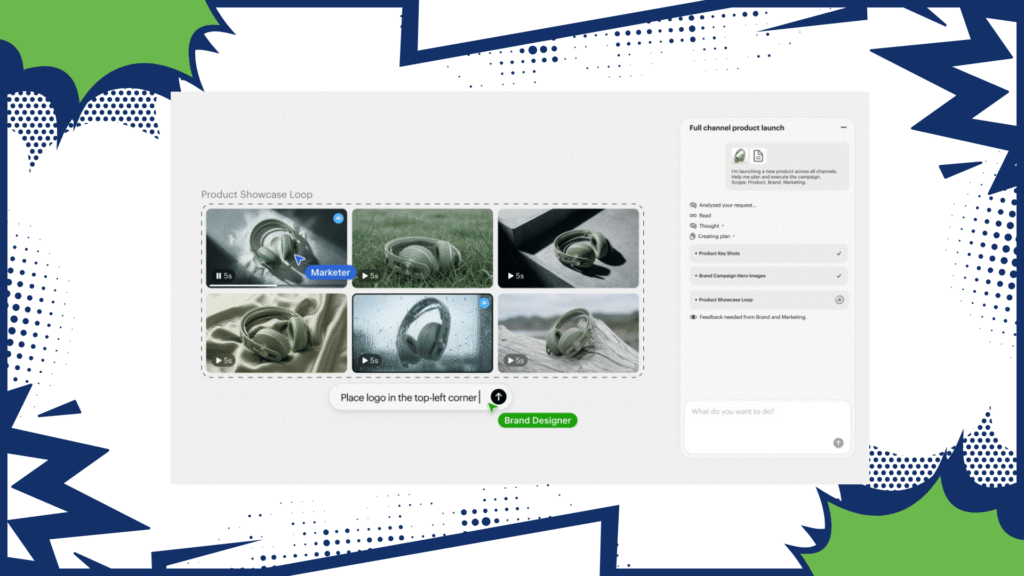
Consequently, the user does not require manually rereading the prompts every time he or she has to make a slight modification. Rather than that, they can facilitate the process with a conversation, as the AI can work on several improvements and variations in the process.
Revamping Innovative Processes
The current AI-based creative processes can be complicated. The number of AI tools available to professionals often is dozens or even hundreds, and each one of them requires certain prompts and technical knowledge.
Luma argues that this complexity makes creative industries slower to adopt. The creative idea is not given much attention by many professionals as much as how to prompt various models.
Luma Agents are trying to make this process easier. Under Unified Intelligence, the AI knows what the user wants and it handles the process of generating it internally. The system can be used in a conversational manner by the person, unlike in the time when one had to manually activate different models.
The system was compared to the way human architects think by Jain. Architects do not merely sketch when creating a building because they visualize the building, the lighting, space dynamics, and the user experience at the same time. Luma is a company whose AI models are designed to replicate a comparable mental formulation of creative tasks.
Real-World Use Cases
In the course of demonstrations, Luma demonstrated the ability of its agents to create campaigns dramatically.
In one instance, the system required a 200-word creative brief and one image of a lipstick product to create a complete advertising concept. The AI recommended possible shooting location, model types, color, and video arrangements to be used in the campaign.
In a different instance, Luma Agents changed a 15-million global advertisement cost into region-specific advertisements. It took only 40 hours and was less than 20,000 and passed the internal quality inspection and accuracy test of the brand.
These findings indicate that AI agents would potentially help in cutting down on the amount of time and money spent in conducting extensive marketing campaigns.
Gradual Public Rollout
As much as Luma Agents can now be accessed via an API, the company will progressively introduce access. By doing this, the startup can provide the reliability of performance and prevent impediments to the workflow of users.
Through a systematic scaling of the platform, Luma is optimistic to gain trust in enterprises which require a regular flow of creative work.
The Future of AI-Fueled Creativity
The launch of Luma Agents presents an indication of a new direction in which AI will be utilized in the creative sectors. Instead of being formed as single instruments, AI systems are transforming into coordinated agents that can handle intricate processes.
If successful, Luma’s Unified Intelligence approach could redefine how advertising campaigns, marketing content, and digital media are produced. Creative professionals may soon spend less time managing tools and more time shaping ideas while AI agents handle the heavy lifting behind the scenes.