logo logo
  • Home
  • About
  • Blogs
  • Services
    • Digital Marketing
    • Social Media Marketing
    • SEO
    • Web Development
    • Video Marketing
    • Content Marketing
  • Contact
Subscribe
Brightveins BlogsBrightveins Blogs
Search
  • Home
  • About
  • Blogs
  • Services
    • Digital Marketing
    • Social Media Marketing
    • SEO
    • Web Development
    • Video Marketing
    • Content Marketing
  • Contact
Subscribe
google-set-to-fix-ai-mode-bug-altering-title-links-and-citations
Blog

Google Set to Fix AI Mode Bug Altering Title Links and Citations

Gaurav Kumar
By
Gaurav Kumar
ByGaurav Kumar
Follow:
Published: April 29, 2026
Share
6 Min Read
SHARE

Google Set to Fix AI Mode Bug Altering Title Links and Citations

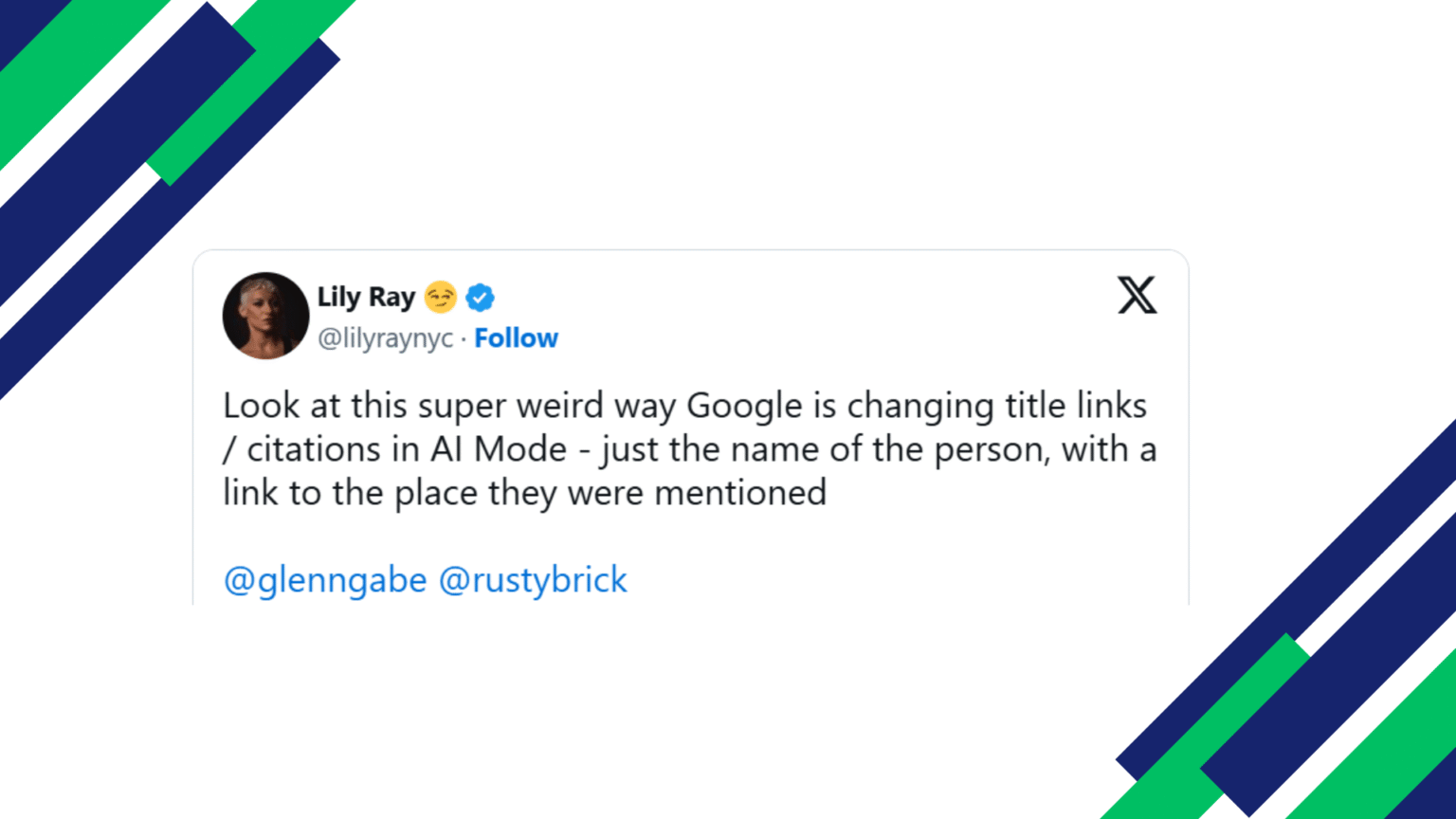
Google is reportedly fixing a bug in its Google AI Mode that alters title links and citations. The bug was brought to light after digital marketing expert Lily Ray posted on X, writing that Google was changing the title links and citations in AI Mode, sometimes replacing them with just the name of a person associated with the place where they were mentioned.

Contents
Google Set to Fix AI Mode Bug Altering Title Links and CitationsWhat Is Google AI Mode?What Is the Bug?This creates several issues:Why Accurate Citations MatterWhat Website Owners Should DoFinal Thoughts

The error is causing debate among SEOs, publishers and creators because citations and links are crucial for both trust, attribution and the user experience. As Google rolls out more AI-enhanced search results, even minor linking bugs can be confusing for users and publishers.

What Is Google AI Mode?

AI Mode is Google’s latest attempt to incorporate AI into search. Rather than simply displaying the usual blue links, AI-powered search results may offer summaries, quick responses, and source citations within the search results themselves.

AI Mode aims to provide quicker answers, while still giving users the opportunity to examine sources by following the citations. But the effectiveness of this approach relies on good attribution and links.

If the title is incorrect or the link is not associated with a correct citation, it could lead to distrust of the search result.

What Is the Bug?

The bug reportedly results in Google AI Mode changing title links and citations in a strange manner. Rather than showing the actual name of the article or the page title, it can show only a name.

For instance, instead of linking to the title of the article, AI Mode may display a name, like an author, expert or celebrity, and then link to where the name appears.

This creates several issues:

  • Users may not know what the content is about
  • Publishers may miss out on traffic for their headline
  • Search results become less informative
  • Citations may seem misleading or lacking
  • While the link may technically lead to the right page, altering the link’s text can reduce accuracy.

Why Accurate Citations Matter

Search engines are based on trust. When someone clicks on a citation link, they want to be sent to the content that matches the headline.

When the article title is not displayed in search results, and only the author’s name is shown, the user may be reluctant to click. For publishers, headlines are also essential to drive reads and present content.

Citations are not just technicalities for journalists, academics, bloggers, and businesses – they are part of their online identity.

This is important for SEO and Publishers

Google is still a significant source of traffic for many sites. With Google rolling out AI summaries and modern search formats, publishers are already adapting to shifts in traffic.

If Google also displays incorrect titles or obscure citations in AI Mode, this could pose further problems for publishers:

Reduced Click-Through Rates

People will be more inclined to click on descriptive titles.

Brand Visibility Loss

Brand and article titles build familiarity. Wrong labels hinder this.

Misattribution Concerns

Displaying just a person’s name might sever a link to a publisher or source.

User Confusion

Users may click on a link thinking it is one thing and it is another.

Google’s Response

According to reports, Google is already aware of the problem and working to resolve it. No official statement has been made about the time frame, but prompt fixes are needed as AI search experiences are prominent and discussed.

Google continually experiments with search technology, particularly new AI features. Issues like this occur as products are developing, but fixes are important to build trust.

Growing Pains of AI Search

This outage reflects a general problem in AI search products. Classic search results were fairly simple: a page title, URL, and snippet. Now AI search systems understand the content, paraphrase it, select sources, and dynamically layout the results.

This new complexity opens up the possibility of errors like:

  • Wrong source selection
  • Misleading summaries
  • Broken context
  • Incorrect labels or titles
  • With the rise of AI search, quality control is crucial.

What Website Owners Should Do

As a website owner or content creator, check your search result listings. Watch for:

  • Incorrect titles
  • Misleading citations
  • Losses in clicks from AI search features
  • Unattributed brand mentions
  • Submitting bugs to official channels and webmaster forums can lead to quicker fixes.

Final Thoughts

The AI Mode citation bug mightn’t look like a big deal, but titles and links are fundamental search elements. When they are wrong, searchers are confused and sites missed.

Thankfully, Google is apparently fixing the issue. As we move forward with AI-powered search, it is clear from bugs like this that transparency, attribution and linking are still vital.

AI may be the future of search, but trust will still rely on fundamentals.

Share This Article
Facebook Copy Link Print
Previous Article microsoft-outlook-lite-for-android-to-stop-working-after-may-25 Microsoft Outlook Lite for Android to Stop Working After May 25
Next Article google-plans-to-invest-up-to-$40-billion-in-anthropic-as-ai-race-intensifies Google Plans to Invest Up to $40 Billion in Anthropic as AI Race Intensifies
Leave a Comment Leave a Comment

Leave a Reply Cancel reply

Your email address will not be published. Required fields are marked *

Let's Connect

FacebookLike
XFollow
PinterestPin
InstagramFollow
YoutubeSubscribe
LinkedInFollow

Popular Posts

startup-depthfirst-says-its-ai-uncovered-previously-unknown-online-flaws-that-anthropic's-mythos-failed-to-detect

Startup Depthfirst says its AI uncovered previously unknown online flaws that Anthropic’s Mythos failed to detect

Gaurav Kumar
9 Min Read
meta-has-hired-the-founders-and-core-team-of-dreamer

 Meta has hired the founders and core team of Dreamer

Gaurav Kumar
7 Min Read
openai-synthid-watermarks-and-new-verification-tools-boost-ai-content-identification

OpenAI’s SynthID Watermarks and New Verification Tools Boost AI Content Identification

Gaurav Kumar
8 Min Read
whatsapp-parent-teen

WhatsApp Adds Pre-Teen Accounts Linked to Parents to Enforce Online Safety

Gaurav Kumar
9 Min Read

You Might Also Like

Blog

Microsoft Build 2026 Unveils Future Tech

7 Min Read
Artificial intelligence has sparked one of the biggest workplace debates of the decade. While some experts warn that automation could eliminate millions of jobs, others believe AI will become a powerful tool that creates entirely new opportunities. Adding his voice to the conversation, Amazon founder Jeff Bezos has shared a much more optimistic outlook. Speaking at the VivaTech conference in Paris, Bezos argued that AI is unlikely to make people obsolete. Instead, he believes the technology will increase the demand for skilled workers, drive innovation, and reshape industries in ways that create more employment rather than reduce it. His perspective offers an important counterpoint to growing concerns about the future of work in an AI-driven world. Why Jeff Bezos Believes AI Will Create More Jobs The fear that artificial intelligence will replace human workers has become increasingly common as AI tools automate repetitive tasks and improve productivity. However, Bezos believes this concern overlooks a bigger reality. According to him, AI will help remove many of the limitations that currently prevent businesses from growing. As organizations become more productive and innovative, they will require more people to build, manage, improve, and expand these new systems. Rather than creating mass unemployment, AI could generate a greater need for skilled professionals across multiple industries. In Bezos' view, technology has historically expanded economic opportunities instead of eliminating them permanently. AI Has Always Changed Jobs–Not Eliminated Work History shows that major technological advancements often transform jobs instead of making human workers unnecessary. The Industrial Revolution introduced machines that automated manufacturing, yet it also created entirely new professions. Similarly, the rise of computers and the internet replaced certain manual tasks while generating millions of careers in software development, digital marketing, cybersecurity, cloud computing, and e-commerce. Artificial intelligence appears to be following the same pattern. Instead of replacing every employee, AI is increasingly taking over repetitive and time-consuming tasks, allowing people to focus on creativity, strategy, decision-making, and customer relationships. This shift could improve productivity while opening the door to entirely new job categories. AI Is Creating New Career Opportunities As AI adoption accelerates, businesses are already hiring professionals with skills that barely existed a few years ago. Emerging roles include: AI Prompt Engineers Machine Learning Specialists AI Product Managers Data Scientists AI Ethics Consultants Automation Experts AI Content Strategists Human-AI Collaboration Specialists Beyond technology companies, sectors such as healthcare, education, finance, manufacturing, logistics, and marketing are increasingly integrating AI into their daily operations. This growing demand suggests that future workplaces will rely on collaboration between humans and intelligent systems rather than replacing one with the other. Not Everyone Shares the Same View While Bezos remains optimistic, opinions across the technology industry are divided. Some business leaders and economists have warned that AI could disrupt entry-level jobs, administrative roles, and repetitive office tasks. There are also concerns that rapid automation could widen skill gaps if workers are not given opportunities to adapt. Labor organizations have emphasized that AI should be implemented responsibly, ensuring productivity gains benefit employees as well as businesses. The broader consensus is that AI's long-term impact will depend less on the technology itself and more on how governments, organizations, and educational institutions prepare the workforce for change. Human Skills Will Become Even More Valuable One area where experts largely agree is that uniquely human abilities will continue to matter. Artificial intelligence can analyze data, generate content, and automate workflows, but it still struggles to replicate qualities such as the following: Creative thinking Emotional intelligence Leadership Critical decision-making Ethical judgment Complex problem-solving Relationship building As AI handles routine tasks, these human-centered skills are expected to become even more valuable in the modern workplace. Rather than competing with AI, professionals who learn to work alongside it are likely to have a significant advantage. Beyond AI: Bezos' Vision for the Future During the conference, Bezos also discussed his long-term ambitions beyond artificial intelligence. He reaffirmed his commitment to space exploration through Blue Origin, emphasizing that humanity should establish a permanent presence on the Moon instead of treating lunar missions as short-term visits. According to Bezos, expanding into space will require continuous innovation in robotics, automation, manufacturing, and AI-powered technologies. Although these projects face technical challenges, they also represent emerging industries that could create entirely new employment opportunities over the coming decades. What Businesses Should Learn from This Regardless of whether every prediction proves accurate, one message is becoming increasingly clear. Artificial intelligence is transforming the workplace. Organizations that invest in employee training, digital skills, and responsible AI adoption will be better positioned to benefit from this technological shift. Rather than viewing AI solely as a cost-cutting tool, forward-thinking businesses are beginning to see it as a way to improve productivity while empowering employees to focus on higher-value work. The future of work will likely be defined by collaboration between human expertise and intelligent automation. Conclusion Jeff Bezos' belief that AI will create more jobs than it replaces offers an encouraging perspective amid widespread uncertainty. While automation will undoubtedly reshape many existing roles, history suggests that technological revolutions often generate new industries, careers, and opportunities that were previously unimaginable. The real challenge is not whether AI will replace people, but whether individuals and organizations are prepared to adapt. For businesses, professionals, and students alike, the future belongs to those who embrace continuous learning, develop uniquely human skills, and understand how to use AI as a powerful partner rather than viewing it solely as a competitor. As artificial intelligence continues to evolve, success may depend less on resisting change and more on learning how to grow alongside it.
Blog

Jeff Bezos Says AI Will Create More Jobs, Not Replace Humans: What It Means for the Future of Work

7 Min Read
agio
Blog

Agio: A graphic and motion design creative force

4 Min Read
google-chrome
Blog

Google Chrome Update Version, Chrome adds new productivity features

8 Min Read

Social Networks

logo

Brightveins partners with businesses to build trust-driven digital legacies through innovation, AI-powered insights, and evolving marketing strategies focusing on long-term growth, strong brand identity, and meaningful impact.

© 2026 — Brightveins. All Rights Reserved.

  • Terms and Conditions
  • Privacy Policy