


Google Introduces New Android Feature to Detect AI-Powered Impersonation Scams
With the ever-growing sophistication of AI, cybercriminals are discovering more and more ways to leverage the technology to their advantage. Voice impersonation scams are one of the most rapidly evolving types of scams where criminals use artificial intelligence to impersonate a familiar voice and trick victims into disclosing sensitive information or wiring funds. In order to prevent that growing threat, Google has released a new security feature for its Phone app that will be able to detect and alert users to suspicious calls pretending to be from contacts.
The feature is included in Google’s newest Android update and is a major improvement in mobile security. Google hopes to reduce the risk of people falling for increasingly sophisticated scams by providing users with a way to easily identify a potential fraud call.
The Threat of AI Voice Scams is increasing.The threat of AI Voice Scams is growing.
Generative AI has revolutionized numerous sectors, but it’s also provided fresh opportunities for cybercriminals. Generating a realistic voice clone from a brief snippet of audio is now possible, allowing scammers to sound more like family members, friends, colleagues or even a figure of authority.
The FBI estimates that in 2025 alone, Americans have been victim to AI-related scams for more than $893 million.Google reports that in 2025 alone, more than $893 million was lost by Americans to AI-related frauds. Few of the scams were conducted using telephone numbers that were fake and with AI-generated voices to create a sense of urgency and trust.
They are often told that the person is someone they know and the victim may give personal information, financial information and other information that leads to the transfer of money. Spam attacks are growing more complex and conventional spam protection programs are becoming inadequate.
How Google’s New Protection Works
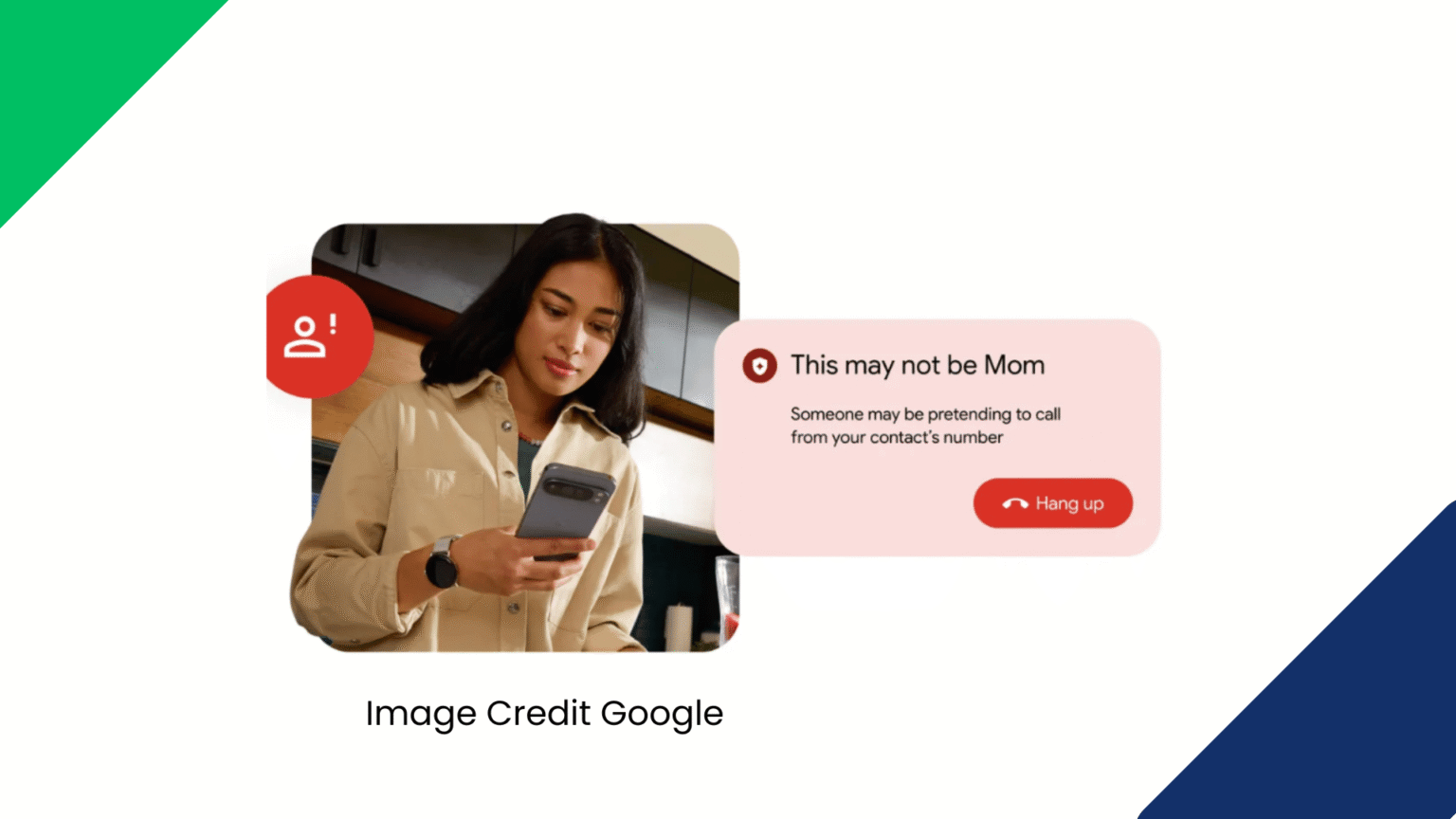
Google’s new security improvement is targeted just at that problem. The Phone by Google app is now able to recognize if a scammer has gone so far as to spoof the phone number of one of your saved contacts, and warns you of suspicious activity.
When the system senses that a caller might be spoofing one of your contacts, users will be notified with the message:
“A fake caller might be calling from your contact’s phone number.”
The warning also gives users the ability to end the call without having to speak with a possible scamster.
This feature is very effective due to its verification procedure. If a legitimate call is made between two people using Phone by Google, the calling device transmits a secure, silent confirmation signal. This signal can verify that the call is actually from the contact’s device.
This verification signal is not present if the phone number being spoofed is by the fraudster. So Google’s system can detect this and warn the recipient that the call might not be legitimate.
Security is the primary concern when it comes to privacy.Security is at the heart of privacy.
Google has stressed that privacy will be an integral component of the feature’s design. It is based on Rich Communication Services (RCS) technology and is secured with end-to-end encryption to ensure that user data remains secure.
The confirmation signal does not reveal content of conversations or personal information, the company claims. Rather, it only validates the authenticity of the device making the call.
The system is open standards, so Google also specifies that other communication applications could work similarly in the future, which could lead to an expanded range of verified, secure communications.
Availability and Rollout
It will be activated automatically on the devices with Android 12 and above (Google Pixel smartphones first). For the protection to take effect, the caller as well as the recipient should be using the Phone by Google application.
The feature is available for Pixel devices at this time, but will eventually be available for more Android devices.
A portion of a bigger Android security patch.
Google’s new scam detection feature is part of its Android update for June. The company also unveils several other features for enhancing user experience and safety.
The enhancements include the addition of AirDrop-like file sharing to an increased number of Android devices, including Samsung’s Galaxy S25 series. Google is also releasing its own Personal Safety app to children under the age of 13, offering more family safety features.
In addition, the AI-powered “clothing try-on” feature for Google Photos is being gradually expanded, and the “Circle to search” function is getting new features to make it easier for users to find and locate items in photos and videos.
Creating trust in the era of AI.
With the ongoing developments in AI technology, it can be tricky to tell the difference between real and faux communication. The new impersonation scam detection tool from Google marks the crucial role of proactive security measures tailored for the AI-driven era.
Encrypted communication standards, real-time warnings and device verification are all part of Google’s efforts to help keep Android users safe from one of the most dangerous cyber threats in today’s world. Although no security solution is foolproof, this development is a major step forward in ensuring users can check who’s on the line.
In an era where fraud schemes are increasingly sophisticated with the help of AI, tools such as these could soon be a must-have in everyday digital safety.