

Google is rolling out another new security camera automation feature to its smart home environment powered by the Gemini AI, which enables security cameras to start routines based on their visual detection. The update is part of a larger group of improvements to Gemini for Home that will help enhance how people interact with their smart home devices to make it smarter, more responsive, and customized.
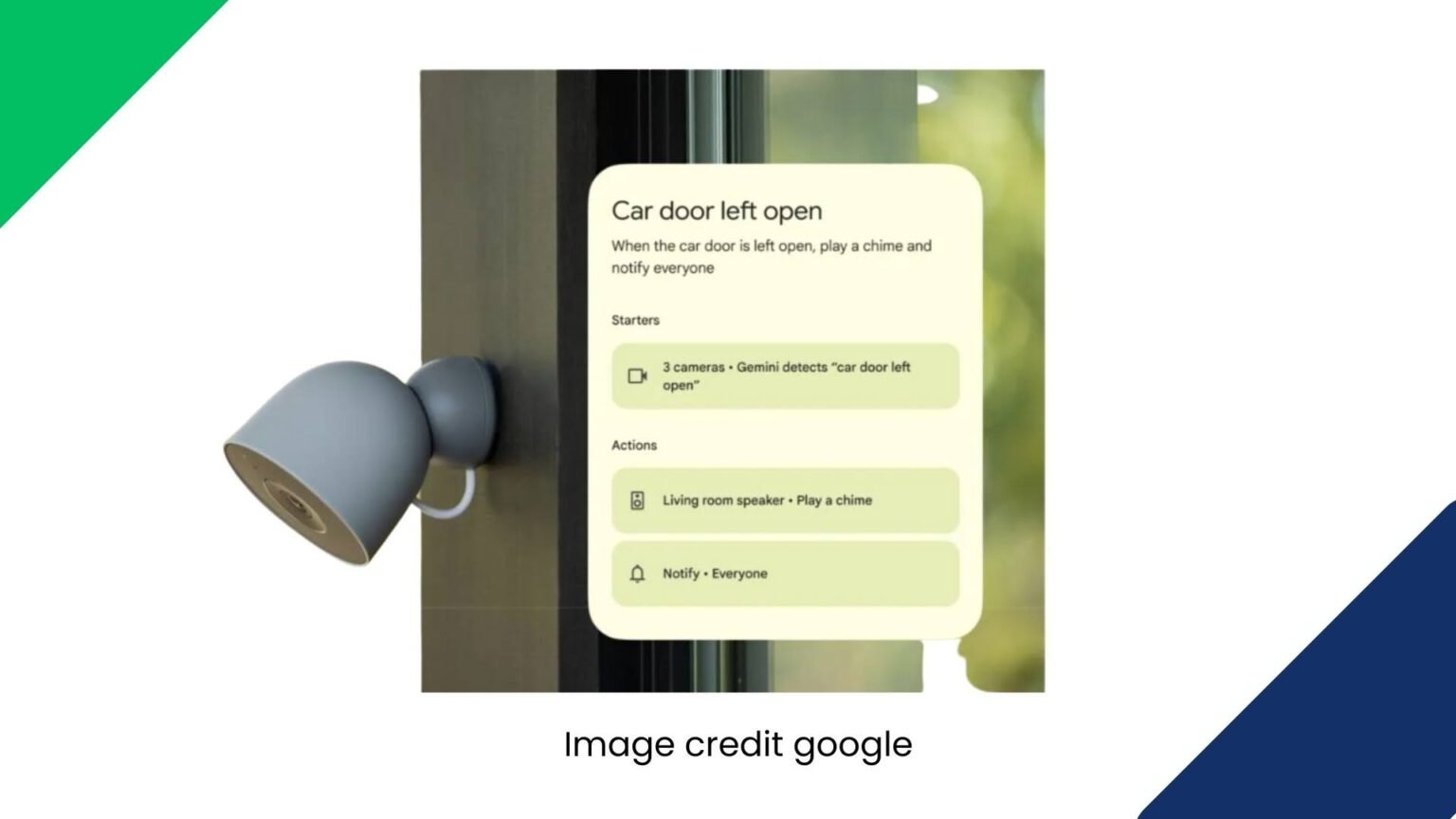
The new automation feature allows people to use a visual understanding gained from the connected cameras to create automations. However, Gemini’s ability to interpret what a camera actually sees means that it can now trigger actions according to what it sees in the environment rather than just relying on motion sensors or pre-defined events.
Google says this is an improvement that lets homeowners create automations through natural language. Users can just define the event they want their smart home to react to, and Gemini will track selected cameras for that event. Upon the event’s detection, the system can automatically trigger a customized routine.
For instance, the smart home can be programmed to know when the mail has arrived and you will get an immediate notification. It can also be used to alert wildlife such as raccoons moving toward trash cans, and activate outdoor security lights to deter them. Other more customized scenarios can also be achieved: such as knowing exactly which car is coming into the driveway, or recognising family members using Google’s Friendly Faces feature. These detections can be used to trigger other actions, such as opening blinds, setting the temperature of the building, or making preparations before a person arrives.
This feature is available for Nest cameras and a limited number of third-party cameras with Gemini Built-In technology. But, it is only available to English speaking users in the United States who are enrolled in the Google Home Public Preview program. AI camera descriptions must also be turned on in Gemini for Home camera settings and users need to pay a premium for Google Home, which costs $20 monthly or $200 per year.
The technology opens up many new automation opportunities, but Google recommends not relying on it for time-sensitive or security-sensitive situations. The feature works best for convenience-based automation and isn’t suitable for emergency alerts or safety-related tasks as it takes some time for the AI to process visual data.
In addition to camera-triggered automations, Google has also improved Gemini’s voice control capabilities. Users can now make several commands in one request, and the assistant will execute several actions at once. For example, you can reduce the blinds, dim the lights, create a timer, and play your favorite podcast with one command.
The company has additionally improved Gemini’s responsiveness and reliability. Voice commands are now acted upon faster and the assistant can better comprehend natural language requests. Features like “a little warmer” when asking the system to make the lights warmer are expected to be more consistent and predictable.
The updates are part of Google’s goal of building a more “contextual” smart home for its devices to understand and respond to both verbal and visual cues. With its blend of cutting-edge AI logic and camera awareness, Gemini for Home transcends mere automation and takes a more intuitive, proactive approach to smart living.
The ability to create routines based on visual triggers exemplifies the progression of home automation toward intelligent systems that can learn and adapt to daily activities without much user input.Visual-triggered routines illustrate the advancements in home automation toward smart environments that interpret and react to everyday activities with limited human interaction.