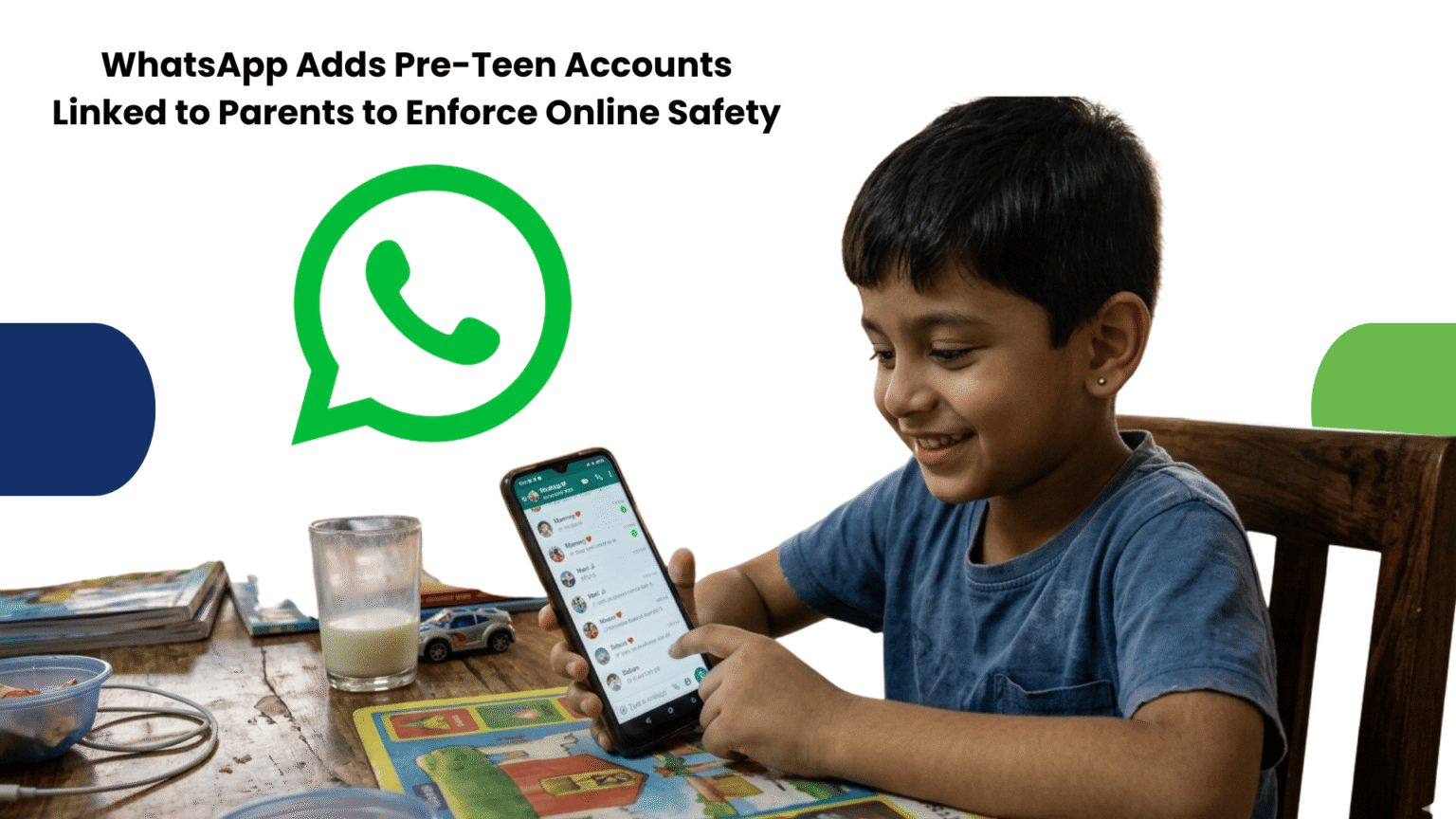

With children having access to smartphones at younger and younger ages, the question of how to keep them safe in the digital world is becoming a concern to both the parents and the tech companies. WhatsApp has met this challenge with a new parent-supervised accounts to pre-teens below the age of 13. The program will assist parents in being in touch with their children besides having a better control of their internet communications.
Though the age rating of WhatsApp is currently 13+ in both Apple App Store and Google Play Store, the company fully understands that lots of younger children already use the application to communicate with their relatives. The company claims that this new feature was developed significantly due to parent feedback. Most parents reported that when they hand over to their children their first mobile phone, it is their desire that they should have a method of enabling them to send SMS to their close family members without exposing them to all the capabilities that the adult user has access to.
Parent-linked accounts are the new type of accounts that are specifically designed to offer only the basic messaging and calling features. These pre-teen accounts will not carry advertisements like regular accounts and some of them will be omitted such as Meta AI, channels and status updates. The functionality is limited to minimize the potential exposure to unwanted content and allow the necessary communication.
The creation of the pre-teen account needs the device of both the parent and the child. The two computers should be verified in the process of setup with a QR code, which has to be properly connected to a parent or a guardian. After the connection is made, the parents are able to set up an assortment of monitoring and safety settings in order to control the activity of the child account.
Activity alerts on parents are one of the main features of this system. The parents are automatically modeled to receive the notification every time the pre-teen user adds a contact or blocks or reports him. Such warning signs will enable a parent to stay alert to the changes in the contacts list of the child and to avoid possible contacts with strangers.
Even further close monitoring can be done by the parents who prefer to activate more optional activity alerts. Such notifications may inform them that their child has changed their name or profile picture, has been requested to chat, has joined or created a group or left an existing group. Alerts can also be activated when disappearing messages are on in a group chat or when a chat or even a contact is erased. Each of these parental control settings is secured with a six-digit PIN which can be set or adjusted directly on the device of the parents.
WhatsApp underlined that it is the aim of the new system to provide the parents with a more powerful control over how their children use messaging services. The company indicated that most parents who are buying smartphones to their pre-teen children only desire a safe means of communication that would enable their children to keep in touch with family members. These parent-managed accounts are thus constructed to meet the communication and supervision and safety needs.
Privacy is a fundamental aspect of the platform even with the restrictions. WhatsApp affirmed that all chats and calls on the accounts of pre-teens will still be encrypted (end-to-end) so that the discussions will be confidential and will not be accessed by the company or any third party.
In order to make things even safer, WhatsApp has added new features to provide extra safeguards when children talk with other people they are not on their contacts list. In case a message request is sent by an unfamiliar number, the user, being in the pre-teen age, will get a context card which will assist him/her with valuable information concerning the sending party. The card can contain information like whether the sender is a member of any group with other users that are pre-teen and the country where the message is sent. This will assist young users in knowing more who tries to contact them before replying.
Other safety features are also provided on the platform as default. As an example, unknown call numbers can easily be silenced to avoid any inconveniences or even harassment. Moreover, photos of unidentified people are automatically blurred, and children are less likely to see the inappropriate material.
All received chat messages of the managed accounts will be stored in a different folder that is locked by PIN of the parent. In the same vein, group invitation links are also encrypted with the same PIN and the children are not allowed to join new groups unless their parents give their permission. WhatsApp will also give a parent information regarding the group such as the number of individuals in the group, and the names of the group administrators before he/she accepts a group invitation.
The other relevant feature of the system is the change to a standard account as the child matures. Once the pre-teen users attain the right age, they will get a notification that their account can be transformed into regular WhatsApp account. The company also stated that it would offer an option whereby parents can postpone this transition up to 12 months so as to provide the family with more flexibility in determining when children should be allowed to have the full access to the platform.
WhatsApp had mentioned that the implementation of such parent related accounts will be in select regions and then a progressive extension to other regions across the world in the next few months. Such a gradual implementation will enable the business to keep track of the efficiency of the new safety devices and improve them in line with the responses of users.
This feature is introduced when the world is growing more concerned with children using social media sites. A number of states such as Denmark, Germany, Spain and the United Kingdom are considering or enacting laws that may limit the use of social media by younger citizens.
Although WhatsApp is not a social network per se, but rather a communication platform, which is more of a messenger, it is a very vital tool in international communication. The company indicates that over three billion individuals in the world use the app to have daily conversations and many families use the app to remain in touch with each other despite the distance.
Introducing parent-linked accounts that pre-teeners could use, WhatsApp is going to provide a more secure online experience to younger audiences but preserve the benefits of instant messaging. The feature is an important contribution to the need to be more responsible in the use of technology amongst children, as parents are empowered to educate and safeguard.