logo logo
  • Home
  • About
  • Blogs
  • Services
    • Digital Marketing
    • Social Media Marketing
    • SEO
    • Web Development
    • Video Marketing
    • Content Marketing
  • Contact
Subscribe
Brightveins BlogsBrightveins Blogs
Search
  • Home
  • About
  • Blogs
  • Services
    • Digital Marketing
    • Social Media Marketing
    • SEO
    • Web Development
    • Video Marketing
    • Content Marketing
  • Contact
Subscribe
Adobe Brand Visibility Explained: AI Search & GEO Guide
Blog

Adobe Brand Visibility: How Adobe Is Helping Brands Win the AI Search Era

Gaurav Kumar
By
Gaurav Kumar
ByGaurav Kumar
Follow:
Published: July 20, 2026
Share
6 Min Read
SHARE

Search is changing faster than ever.
For years, businesses focused on ranking higher on traditional search engines like Google. Today, however, millions of people are turning to AI-powered platforms such as ChatGPT, Google AI Mode, Microsoft Copilot, and Perplexity AI to research products, compare services, and make purchasing decisions.

Contents
Why AI Search Is Becoming the New Digital BattlegroundWhat Is Adobe Brand Visibility?Understanding Generative Engine Optimization (GEO)Key Features of Adobe Brand VisibilityAI Visibility InsightsPrompt IntelligenceCompetitor AnalysisAI-Powered OptimizationCombined SEO and GEO IntelligenceWhy This Matters for Digital MarketersThe Future of Search Is AI-DrivenConclusion 

This shift has introduced a new challenge for marketers: How do you ensure your brand appears in AI-generated answers—not just search engine results?

Adobe believes it has the solution.

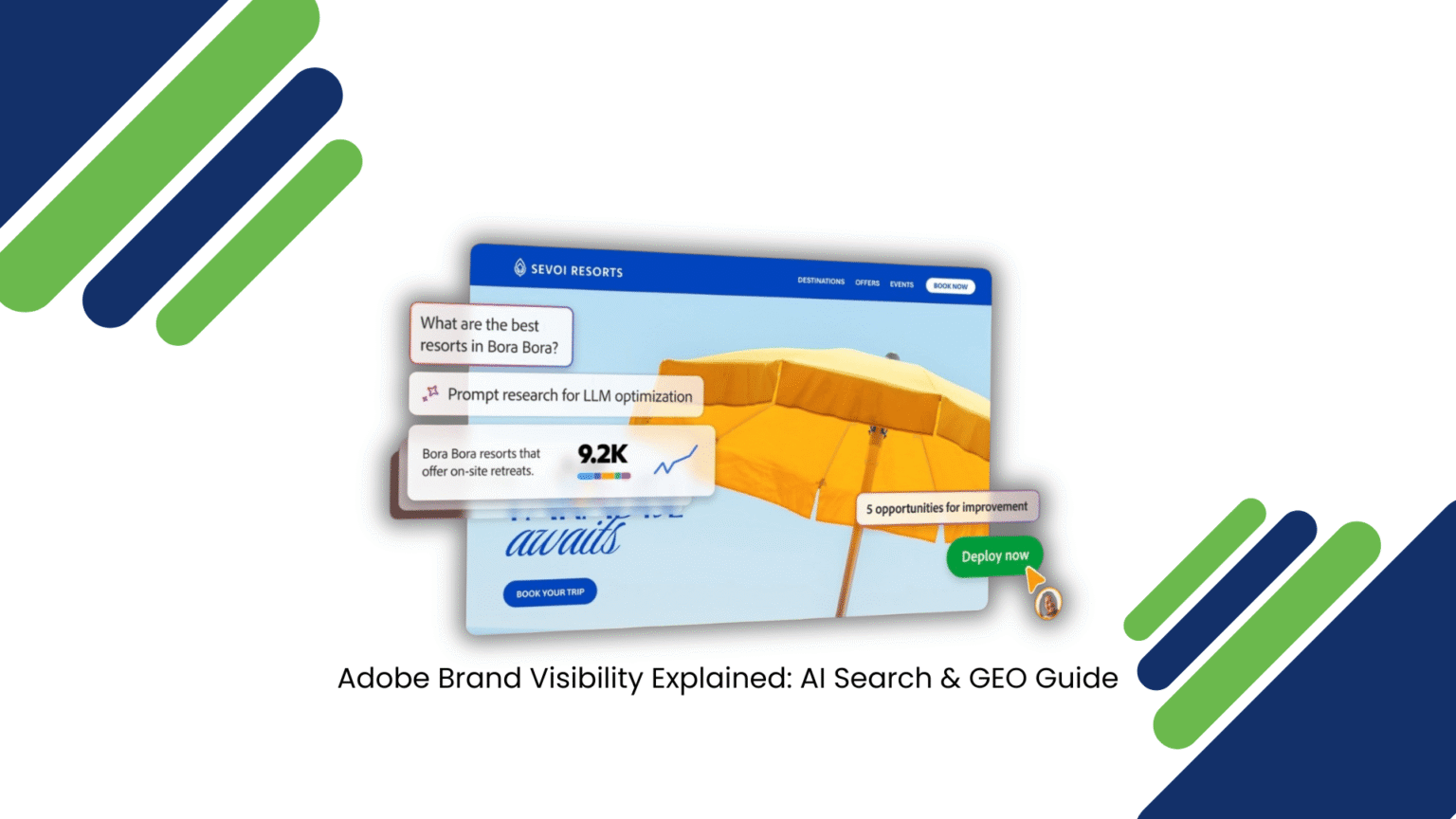
With the launch of Adobe Brand Visibility, businesses can now monitor, analyze, and improve how their brands appear across AI-driven search platforms. More than just another SEO tool, it introduces a new approach known as Generative Engine Optimization (GEO)—a strategy designed specifically for the age of AI search.

Why AI Search Is Becoming the New Digital Battleground

The way people search online is rapidly evolving.

Instead of browsing multiple websites, users increasingly ask AI assistants direct questions such as:

  • Which CRM software is best for startups?
  • What are the top digital marketing agencies?
  • Best hotels in Dubai for families?

Rather than displaying a list of links, AI tools provide summarized answers that often recommend specific brands.

If your business isn’t mentioned in these AI-generated responses, you’re missing valuable visibility—even if your website ranks well on traditional search engines.

This changing behavior is making AI visibility just as important as conventional SEO.

What Is Adobe Brand Visibility?

Adobe Brand Visibility is a new AI-powered marketing solution designed to help businesses understand and improve their presence across AI search platforms.

Instead of tracking only search rankings, the platform monitors how frequently a brand appears in AI-generated responses, identifies the topics driving those mentions, and provides recommendations to improve visibility.

It combines Adobe’s AI content optimization technology with Semrush’s extensive SEO intelligence, creating a unified platform for managing both traditional search performance and AI-driven discovery.

The goal is simple: help brands become the answers AI assistants recommend.

Understanding Generative Engine Optimization (GEO)

Traditional SEO focuses on improving rankings within search engine results pages.

Generative Engine Optimization (GEO) takes a different approach.

Its objective is to increase the likelihood that AI systems reference your brand when generating responses.

Instead of optimizing only for keywords, GEO considers factors such as:

  • Content quality and authority
  • Brand credibility
  • Topic relevance
  • Structured information
  • User intent
  • AI-friendly content organization

As AI search continues to expand, GEO is expected to become a critical component of modern digital marketing strategies.

Key Features of Adobe Brand Visibility

Adobe has introduced several capabilities designed specifically for the AI search ecosystem.

AI Visibility Insights

Businesses can see how often their brand appears across leading AI platforms, helping marketers measure their influence beyond traditional search rankings.

Prompt Intelligence

The platform identifies the prompts and topics users frequently ask AI assistants, allowing businesses to create content that aligns with emerging customer interests.

Competitor Analysis

Brands can compare their AI visibility against competitors, revealing who dominates important topics and where new opportunities exist.

AI-Powered Optimization

Instead of manually analyzing performance, the platform recommends content improvements that can strengthen AI visibility while supporting traditional SEO.

Combined SEO and GEO Intelligence

By integrating Semrush’s extensive keyword and backlink database, Adobe enables businesses to manage search engine optimization and AI search optimization from one platform.

Why This Matters for Digital Marketers

The launch of Adobe Brand Visibility reflects a larger transformation in digital marketing.

Success is no longer measured solely by website rankings.

Businesses now need to understand the following:

  • Whether AI platforms mention their brand.
  • Which topics generate the most visibility.
  • How competitors appear in AI-generated recommendations.
  • Which content influences AI responses.
  • How AI-driven traffic contributes to business growth.

For marketing teams, this means expanding beyond conventional SEO and embracing strategies designed specifically for AI-powered search experiences.

The Future of Search Is AI-Driven

Consumer behavior is changing rapidly.

People increasingly expect instant, conversational answers instead of scrolling through pages of search results.

As a result, AI assistants are becoming trusted sources for product recommendations, travel planning, software comparisons, and purchasing advice.

Businesses that adapt early by optimizing their content for both humans and AI systems will likely gain a competitive advantage as AI search adoption continues to grow.

Tools like Adobe Brand Visibility represent the beginning of this new optimization era.

Conclusion 

Adobe Brand Visibility isn’t simply another SEO platform -it’s a glimpse into the future of digital marketing.

As AI-powered search reshapes how people discover information, businesses must rethink how they build online visibility.

By combining traditional SEO insights with generative engine optimization, Adobe is helping organizations prepare for a future where success depends not only on ranking in search engines but also on becoming the trusted answer AI chooses to recommend.

For marketers, agencies, and businesses alike, the message is clear: the future of search is no longer just about being found- it’s about being chosen by AI.


Share This Article
Facebook Copy Link Print
Previous Article Amazon Introduces AI-Powered Visual Search How Generative AI Is Changing Online Shopping Amazon Introduces AI-Powered Visual Search: How Generative AI Is Changing Online Shopping
Next Article Artificial intelligence has sparked one of the biggest workplace debates of the decade. While some experts warn that automation could eliminate millions of jobs, others believe AI will become a powerful tool that creates entirely new opportunities. Adding his voice to the conversation, Amazon founder Jeff Bezos has shared a much more optimistic outlook. Speaking at the VivaTech conference in Paris, Bezos argued that AI is unlikely to make people obsolete. Instead, he believes the technology will increase the demand for skilled workers, drive innovation, and reshape industries in ways that create more employment rather than reduce it. His perspective offers an important counterpoint to growing concerns about the future of work in an AI-driven world. Why Jeff Bezos Believes AI Will Create More Jobs The fear that artificial intelligence will replace human workers has become increasingly common as AI tools automate repetitive tasks and improve productivity. However, Bezos believes this concern overlooks a bigger reality. According to him, AI will help remove many of the limitations that currently prevent businesses from growing. As organizations become more productive and innovative, they will require more people to build, manage, improve, and expand these new systems. Rather than creating mass unemployment, AI could generate a greater need for skilled professionals across multiple industries. In Bezos' view, technology has historically expanded economic opportunities instead of eliminating them permanently. AI Has Always Changed Jobs–Not Eliminated Work History shows that major technological advancements often transform jobs instead of making human workers unnecessary. The Industrial Revolution introduced machines that automated manufacturing, yet it also created entirely new professions. Similarly, the rise of computers and the internet replaced certain manual tasks while generating millions of careers in software development, digital marketing, cybersecurity, cloud computing, and e-commerce. Artificial intelligence appears to be following the same pattern. Instead of replacing every employee, AI is increasingly taking over repetitive and time-consuming tasks, allowing people to focus on creativity, strategy, decision-making, and customer relationships. This shift could improve productivity while opening the door to entirely new job categories. AI Is Creating New Career Opportunities As AI adoption accelerates, businesses are already hiring professionals with skills that barely existed a few years ago. Emerging roles include: AI Prompt Engineers Machine Learning Specialists AI Product Managers Data Scientists AI Ethics Consultants Automation Experts AI Content Strategists Human-AI Collaboration Specialists Beyond technology companies, sectors such as healthcare, education, finance, manufacturing, logistics, and marketing are increasingly integrating AI into their daily operations. This growing demand suggests that future workplaces will rely on collaboration between humans and intelligent systems rather than replacing one with the other. Not Everyone Shares the Same View While Bezos remains optimistic, opinions across the technology industry are divided. Some business leaders and economists have warned that AI could disrupt entry-level jobs, administrative roles, and repetitive office tasks. There are also concerns that rapid automation could widen skill gaps if workers are not given opportunities to adapt. Labor organizations have emphasized that AI should be implemented responsibly, ensuring productivity gains benefit employees as well as businesses. The broader consensus is that AI's long-term impact will depend less on the technology itself and more on how governments, organizations, and educational institutions prepare the workforce for change. Human Skills Will Become Even More Valuable One area where experts largely agree is that uniquely human abilities will continue to matter. Artificial intelligence can analyze data, generate content, and automate workflows, but it still struggles to replicate qualities such as the following: Creative thinking Emotional intelligence Leadership Critical decision-making Ethical judgment Complex problem-solving Relationship building As AI handles routine tasks, these human-centered skills are expected to become even more valuable in the modern workplace. Rather than competing with AI, professionals who learn to work alongside it are likely to have a significant advantage. Beyond AI: Bezos' Vision for the Future During the conference, Bezos also discussed his long-term ambitions beyond artificial intelligence. He reaffirmed his commitment to space exploration through Blue Origin, emphasizing that humanity should establish a permanent presence on the Moon instead of treating lunar missions as short-term visits. According to Bezos, expanding into space will require continuous innovation in robotics, automation, manufacturing, and AI-powered technologies. Although these projects face technical challenges, they also represent emerging industries that could create entirely new employment opportunities over the coming decades. What Businesses Should Learn from This Regardless of whether every prediction proves accurate, one message is becoming increasingly clear. Artificial intelligence is transforming the workplace. Organizations that invest in employee training, digital skills, and responsible AI adoption will be better positioned to benefit from this technological shift. Rather than viewing AI solely as a cost-cutting tool, forward-thinking businesses are beginning to see it as a way to improve productivity while empowering employees to focus on higher-value work. The future of work will likely be defined by collaboration between human expertise and intelligent automation. Conclusion Jeff Bezos' belief that AI will create more jobs than it replaces offers an encouraging perspective amid widespread uncertainty. While automation will undoubtedly reshape many existing roles, history suggests that technological revolutions often generate new industries, careers, and opportunities that were previously unimaginable. The real challenge is not whether AI will replace people, but whether individuals and organizations are prepared to adapt. For businesses, professionals, and students alike, the future belongs to those who embrace continuous learning, develop uniquely human skills, and understand how to use AI as a powerful partner rather than viewing it solely as a competitor. As artificial intelligence continues to evolve, success may depend less on resisting change and more on learning how to grow alongside it. Jeff Bezos Says AI Will Create More Jobs, Not Replace Humans: What It Means for the Future of Work
Leave a Comment Leave a Comment

Leave a Reply Cancel reply

Your email address will not be published. Required fields are marked *

Let's Connect

FacebookLike
XFollow
PinterestPin
InstagramFollow
YoutubeSubscribe
LinkedInFollow

Popular Posts

openai-smartphones-are-coming-may-be-on-the-horizon-sooner

OpenAI Smartphones are Coming May be On the Horizon Sooner

Gaurav Kumar
9 Min Read
adobe-completes-acquisition-of-semrush-enhancing-brand-visibility

Adobe Completes Acquisition of Semrush, Enhancing Brand Visibility

Gaurav Kumar
5 Min Read
meta-partners-with-aws-on-graviton-chips-to-power-the-next-wave-of-agentic-ai

Meta Partners With AWS on Graviton Chips to Power the Next Wave of Agentic AI

Gaurav Kumar
7 Min Read
Google Sans Flex Open Font License

Google Sans Flex Open Font License

Gaurav Kumar
6 Min Read

You Might Also Like

taxi-1
Blog

India Cooperative cab service – Bharat Taxi

8 Min Read
claude-code-and-claude-cowork
Blog

Claude Code and Claude Cowork

8 Min Read
gemini-advantage
Blog

Gemini Advantage in Google Marketing Platform

7 Min Read
Artificial intelligence has sparked one of the biggest workplace debates of the decade. While some experts warn that automation could eliminate millions of jobs, others believe AI will become a powerful tool that creates entirely new opportunities. Adding his voice to the conversation, Amazon founder Jeff Bezos has shared a much more optimistic outlook. Speaking at the VivaTech conference in Paris, Bezos argued that AI is unlikely to make people obsolete. Instead, he believes the technology will increase the demand for skilled workers, drive innovation, and reshape industries in ways that create more employment rather than reduce it. His perspective offers an important counterpoint to growing concerns about the future of work in an AI-driven world. Why Jeff Bezos Believes AI Will Create More Jobs The fear that artificial intelligence will replace human workers has become increasingly common as AI tools automate repetitive tasks and improve productivity. However, Bezos believes this concern overlooks a bigger reality. According to him, AI will help remove many of the limitations that currently prevent businesses from growing. As organizations become more productive and innovative, they will require more people to build, manage, improve, and expand these new systems. Rather than creating mass unemployment, AI could generate a greater need for skilled professionals across multiple industries. In Bezos' view, technology has historically expanded economic opportunities instead of eliminating them permanently. AI Has Always Changed Jobs–Not Eliminated Work History shows that major technological advancements often transform jobs instead of making human workers unnecessary. The Industrial Revolution introduced machines that automated manufacturing, yet it also created entirely new professions. Similarly, the rise of computers and the internet replaced certain manual tasks while generating millions of careers in software development, digital marketing, cybersecurity, cloud computing, and e-commerce. Artificial intelligence appears to be following the same pattern. Instead of replacing every employee, AI is increasingly taking over repetitive and time-consuming tasks, allowing people to focus on creativity, strategy, decision-making, and customer relationships. This shift could improve productivity while opening the door to entirely new job categories. AI Is Creating New Career Opportunities As AI adoption accelerates, businesses are already hiring professionals with skills that barely existed a few years ago. Emerging roles include: AI Prompt Engineers Machine Learning Specialists AI Product Managers Data Scientists AI Ethics Consultants Automation Experts AI Content Strategists Human-AI Collaboration Specialists Beyond technology companies, sectors such as healthcare, education, finance, manufacturing, logistics, and marketing are increasingly integrating AI into their daily operations. This growing demand suggests that future workplaces will rely on collaboration between humans and intelligent systems rather than replacing one with the other. Not Everyone Shares the Same View While Bezos remains optimistic, opinions across the technology industry are divided. Some business leaders and economists have warned that AI could disrupt entry-level jobs, administrative roles, and repetitive office tasks. There are also concerns that rapid automation could widen skill gaps if workers are not given opportunities to adapt. Labor organizations have emphasized that AI should be implemented responsibly, ensuring productivity gains benefit employees as well as businesses. The broader consensus is that AI's long-term impact will depend less on the technology itself and more on how governments, organizations, and educational institutions prepare the workforce for change. Human Skills Will Become Even More Valuable One area where experts largely agree is that uniquely human abilities will continue to matter. Artificial intelligence can analyze data, generate content, and automate workflows, but it still struggles to replicate qualities such as the following: Creative thinking Emotional intelligence Leadership Critical decision-making Ethical judgment Complex problem-solving Relationship building As AI handles routine tasks, these human-centered skills are expected to become even more valuable in the modern workplace. Rather than competing with AI, professionals who learn to work alongside it are likely to have a significant advantage. Beyond AI: Bezos' Vision for the Future During the conference, Bezos also discussed his long-term ambitions beyond artificial intelligence. He reaffirmed his commitment to space exploration through Blue Origin, emphasizing that humanity should establish a permanent presence on the Moon instead of treating lunar missions as short-term visits. According to Bezos, expanding into space will require continuous innovation in robotics, automation, manufacturing, and AI-powered technologies. Although these projects face technical challenges, they also represent emerging industries that could create entirely new employment opportunities over the coming decades. What Businesses Should Learn from This Regardless of whether every prediction proves accurate, one message is becoming increasingly clear. Artificial intelligence is transforming the workplace. Organizations that invest in employee training, digital skills, and responsible AI adoption will be better positioned to benefit from this technological shift. Rather than viewing AI solely as a cost-cutting tool, forward-thinking businesses are beginning to see it as a way to improve productivity while empowering employees to focus on higher-value work. The future of work will likely be defined by collaboration between human expertise and intelligent automation. Conclusion Jeff Bezos' belief that AI will create more jobs than it replaces offers an encouraging perspective amid widespread uncertainty. While automation will undoubtedly reshape many existing roles, history suggests that technological revolutions often generate new industries, careers, and opportunities that were previously unimaginable. The real challenge is not whether AI will replace people, but whether individuals and organizations are prepared to adapt. For businesses, professionals, and students alike, the future belongs to those who embrace continuous learning, develop uniquely human skills, and understand how to use AI as a powerful partner rather than viewing it solely as a competitor. As artificial intelligence continues to evolve, success may depend less on resisting change and more on learning how to grow alongside it.
Blog

Jeff Bezos Says AI Will Create More Jobs, Not Replace Humans: What It Means for the Future of Work

7 Min Read

Social Networks

logo

Brightveins partners with businesses to build trust-driven digital legacies through innovation, AI-powered insights, and evolving marketing strategies focusing on long-term growth, strong brand identity, and meaningful impact.

© 2026 — Brightveins. All Rights Reserved.

  • Terms and Conditions
  • Privacy Policy