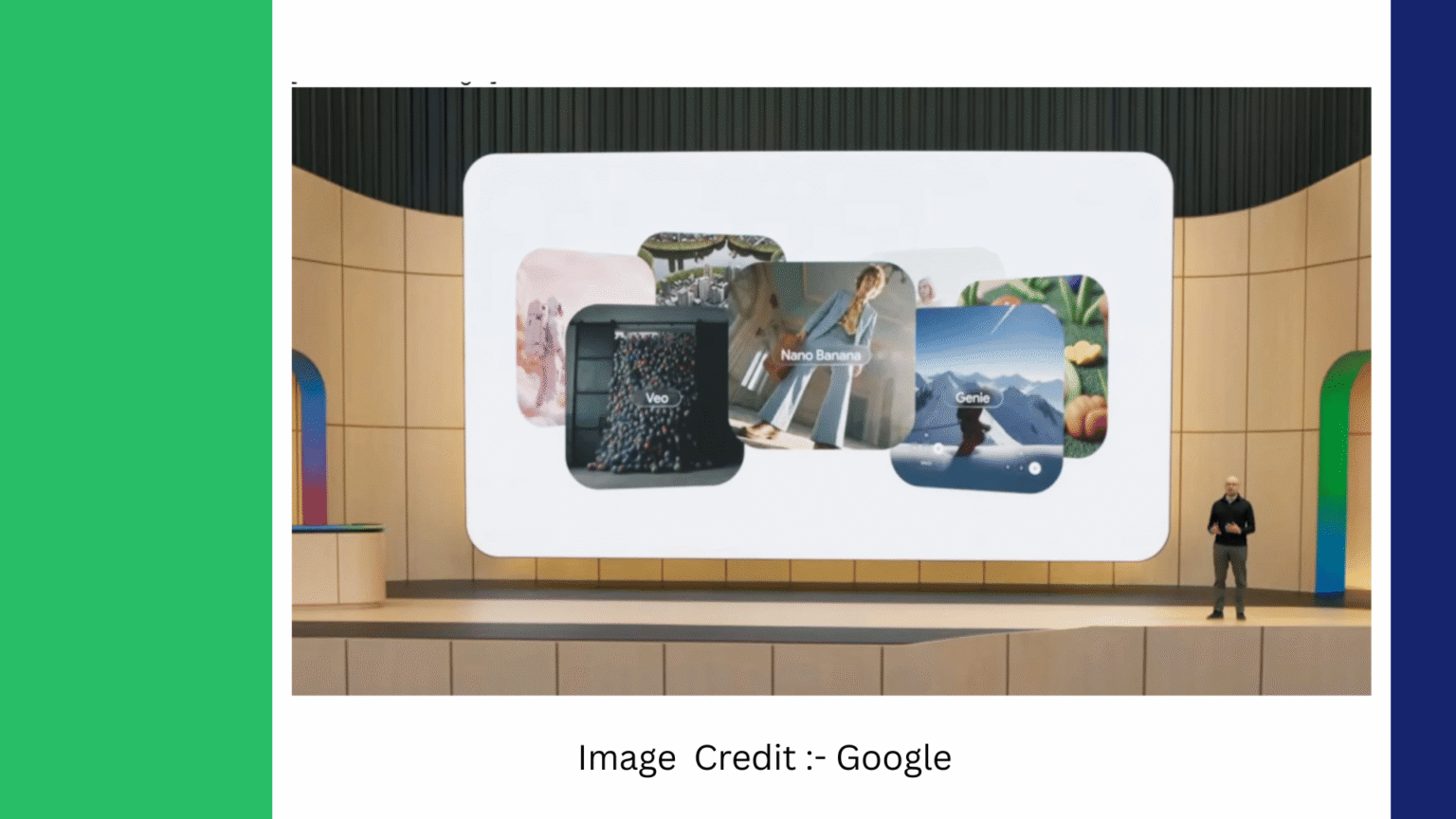


One point was made loud and clear at this year’s developer conference: AI is no longer just a secondary feature to Google’s products; it’s the backbone of everything to come. Over the course of a number of key announcements made at Google I/O, the tech giant unveiled new AI models, personal AI agents, improved search features, coding tools, and a new “world model” that would be able to create realistic videos using physical reasoning. All these advances demonstrate that Google is evolving its long-running mantra of organizing the world’s information into one that can reason about it and take actions on behalf of users.
Google has been successful for years and the reason for this is search. Its crawling, organizing and ranking the web earned the company a place in tech history as one of the most influential companies. Today, however, the company has to contend with new rivals in the form of quickly rising generative AI start-ups like OpenAI and Anthropic. With the latest news, Google has left the defensive posture it had adopted since the AI revolution. Rather, it’s positioning itself as a firm that’s uniquely poised to be the company that’ll lead the next generation of intelligent systems.
The bond of this strategy is the Gemini AI models. Google is releasing a new fast and efficient multimodal model, Gemini 3.5 Flash, which is optimized for reasoning, coding, tool use and long-horizon tasks. Google claims the model is much more efficient in terms of speed and cost when compared to other frontier AI models and has improved upon previous versions of Gemini in a number of benchmarks. It also teased the more advanced flagship Gemini 3.5 Pro which will go public once it is through safety testing.
The special thing about the Gemini strategy is that it’s intelligence that is action driven. Google is no longer creating models that provide answers to questions. Rather, it’s building AI systems that can use tools, follow instructions, reason through complex workflows, and execute tasks on behalf of the user. This trend is one towards “agentic AI” and is becoming a key part of the company’s future vision.
One of the most lofty announcements was Google’s new “world model” called Gemini. While conventional AI video generators are limited to visuals, Gemini Omni aims to comprehend the workings of the real world. The model can create video and environments that are physically consistent, logically coherent, and smartly follow multimodal instructions in the form of text, image, audio, and video. For instance, users can upload their own image and insert themselves into generated scenes, maintaining realistic movement and interactions thanks to AI reasoning capabilities.
With the release of Gemini Omni, Google is making its first foray into a growing trend of developing AI models that can mimic reality itself. Google has now introduced the multimodal understanding, along with physics-based reasoning, to develop AI-generated experiences that are more natural, accurate, and immersive. Part of this may be down to Google having a huge training facility and access to huge amounts of data, such as the vast library of YouTube videos that can be used to teach AI systems about objects moving, human behaviour etc.
One of the biggest advantages Google has in the AI competition is its infrastructure. In the leadup to I/O, Google highlighted its huge investments in data centers and AI hardware. This year, the company plans to spend billions of dollars on AI infrastructure, a large part of which will be on growing its custom Tensor Processing Units (TPUs). Google claims that its AI training systems are now able to use multiple TPUs, spread across more than a million devices around the world, to form one of the world’s largest AI computing clusters.
This is not all about hardware. Google has been developing one of the world’s most sophisticated systems to index websites for decades. It’s web crawlers are constantly crawling and categorizing internet contents into a huge knowledge graph on people, places, organizations, events, products and concepts. That structured information gives an extensive edge to train AI systems that demand high-quality, real-world information.
Google has a lot of platforms and ecosystems in which digital information is generated and used, and unlike smaller AI startups that rely on partnerships or publicly available data, it owns many. The volume of data and signals of user interaction across Search, Gmail, Maps, Android, YouTube, Workspace and Chrome is enormous. This ecosystem provides Google with a solid platform for developing AI systems that are seamlessly integrated into daily life.
The company’s re-emerging attention to consumer AI products was also noteworthy at the event. Many industry watchers have been predicting that enterprise AI would be a major topic of conversation, but Google instead demos tools directly for the user. One such example is Gemini Spark, a personal AI agent that remains constantly active and can help with various tasks. Spark integrates with Gmail, Google Docs, Google Slides and other Workspace apps, so it can understand your preferences, summarize documents, check your inboxes, schedule events and even complete multistep workflows.
Spark will eventually offer third-party connections like Canva, OpenTable, and Instacart, and will let users set up subagents for specific tasks, Google says. The company is certainly taking a step towards a future where AI assistants are not simply chatbots but proactive digital employees capable of handling information and performing actions on their own.
Perhaps, the most crucial change is going on in Google Search itself. Many analysts initially thought that this will pose risks to Google’s search advertising business, as conversational AI responses can replace the traditional search results. But, Google seems to have turned AI into a search compliment instead of a search substitute.
AI Overviews and AI Mode capabilities are now in the search experience, giving consumers conversational summaries without sacrificing traditional search results and ads. In fact, Google says that AI-driven searches are boosting engagement and sparking more searches in general. AI offers a chance to enhance, rather than disrupt, its advertising operations, making search more interactive and useful.
Google’s upcoming “Ask YouTube” feature is yet another example of the integration of AI into content discovery. The user will soon be able to ask the questions directly about the content of the video, and AI will analyze and summarize the content from several videos. This changes the nature of search from a retrieval system to an intelligent reasoning layer that understands and composes information throughout the Web.
In the end, Google’s AI vision is becoming more clear. With its vast infrastructure, search influence, data ecosystem, and consumer platforms, the company is tapping into its strength to build AI systems capable of more than just content creation. Google’s goal with Gemini is to create “intelligent agents” capable of comprehending data, reasoning about it and, over time, taking actions on its behalf. As the world of AI is rapidly changing, Google is not merely a provider of AI models, but a company striving to make AI a part of every facet of digital living.