logo logo
  • Home
  • About
  • Blogs
  • Services
    • Digital Marketing
    • Social Media Marketing
    • SEO
    • Web Development
    • Video Marketing
    • Content Marketing
  • Contact
Subscribe
Brightveins BlogsBrightveins Blogs
Search
  • Home
  • About
  • Blogs
  • Services
    • Digital Marketing
    • Social Media Marketing
    • SEO
    • Web Development
    • Video Marketing
    • Content Marketing
  • Contact
Subscribe
9-5google
Blog

Google launches Google Home ‘Live Search’ with AI

Gaurav Kumar
By
Gaurav Kumar
ByGaurav Kumar
Follow:
Published: March 11, 2026
Share
8 Min Read
SHARE
Highlights
  • AI monitors your home and answers questions using live camera feeds.
  • Just ask a question instead of checking camera footage manually.
  • Shows live and recent activity for better home awareness.

Artificial intelligence is one of the strongest elements of smart home technology that is developing at a hectic pace. Google has come up with a new feature known as Google Home Live Search in order to make home monitoring smart and easy to navigate. This feature is expected to enable the user to have a quick grasp of what is going on within and around their homes by inquiring questions. Rather than checking camera footage manually, users can now use the help of AI to scan their homes and give real-time answers.

Recently, the updates to Google Home allow the owners of Nest Cam devices to interact with the camera feeds in a brand new manner. Instead of browsing through the recorded clips or live streaming, the user is able to pose the system questions and get immediate answers depending on what is being observed by the cameras. The feature applies a Google AI model, Gemini, that scans the live feeds of the cameras and processes the image information to provide useful responses.

The AI Redefining Smart Homes

Conventionally, the smart home cameras were primarily applied in recording video and alerting once they detected motion or activity. Although this was practical, most of the time it was necessary to open the application and manually view the footage to know what transpired.

In the new Live Search, this functionality goes far beyond it. It turns intelligent cameras into an intelligent assistant capable of comprehending questions and intelligible video data. This implies that there is no longer a need to waste time in browsing recorded videos. Rather, they only have to pose a query and leave the AI to do the job.

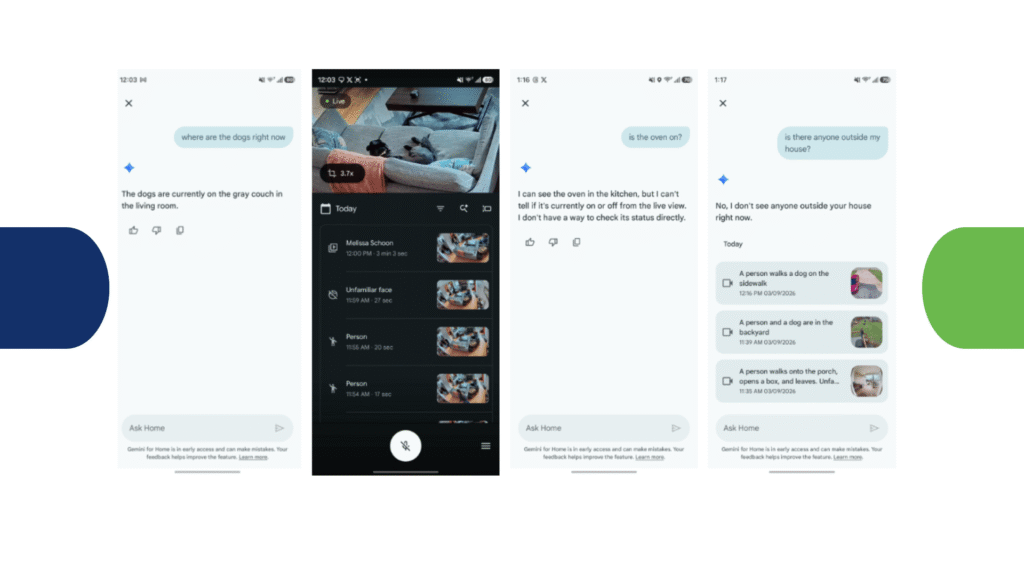
As an example, in case one wants to know whether there is a guest outside their house or even whether their pet is in a specific room, all they have to do is to type or talk the actual question on the Google Home application. The AI can scrutinize the accessible camera feeds and deliver a definite response within a matter of seconds.
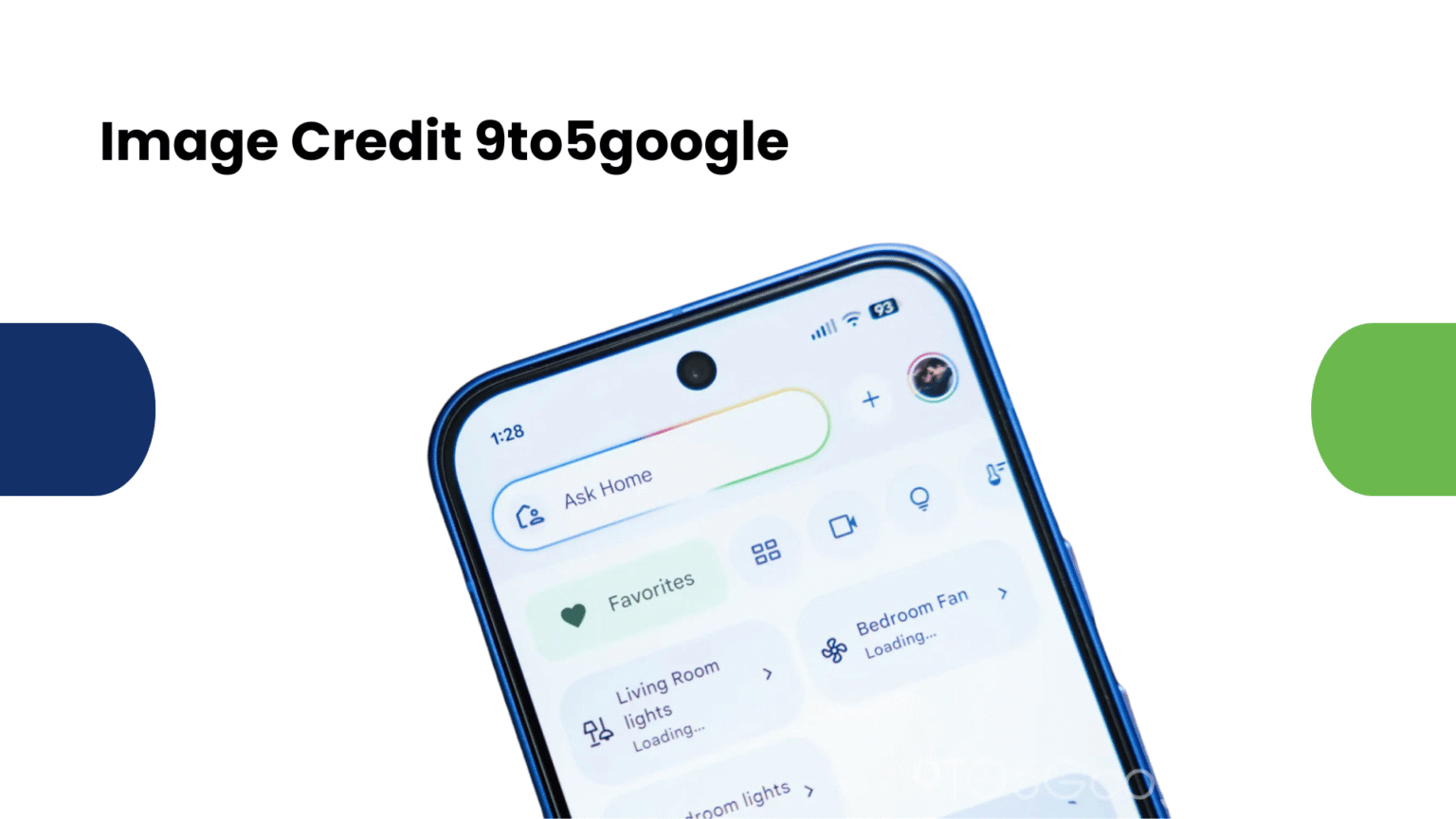
9to5google
Image Credit :- 9to5google

The working of Google Home Live Search

Live search is also incorporated into the Google Home app search bar which is called Ask Home. Upon a question being posed by a user, Gemini AI will scan the live camera streams that are connected to the system automatically. It takes the visual input and makes a response depending on the detecting information.

The fact that it integrates the live footage and the past is one of the most useful features of this feature. Although this system mostly is concerned about the present, it may be used to refer to the recent recorded clips in case it is obligatory. This enables the AI to give a greater context in answering questions on the recent activity.

As an example, when a person questions whether there was any activity outside of his or her house within the recent past, the AI could present footage of what happened within the last few hours and what is happening right now.

Live Search in the Real World

Some interesting capabilities have been demonstrated in the Live Search feature in practical testing. On querying it, Where are the dogs at this moment, the system searched the camera feeds and responded that the dogs were in the living room at the sofa. Even though the number of the dogs was two, and only one was on the sofa, the rest being in the other location of the room, the AI still managed to identify the primary activity in the room.

The other test question was on whether the oven had been turned on or not. Gemini in this instance replied that it could not know this by the mere view of the camera. This reaction brings out a crucial part of the system- it does not make any assumptions where the information cannot be verified by the visual aspect. Rather, it gives a realistic and true answer in accordance to what it is capable of detecting.

Upon a query of such nature as Is someone outside my house, the system was able to describe the situation at hand as well as give clips of previous activity over the past few hours. This will assist users to be able to quickly know whether a person has approached the house recently or whether the place has been silent.

Why This Feature Matters

To a large user base, viewing camera feeds in seconds may be rapid enough. Nevertheless, Live Search comes in so handy when using in houses with more than one camera. The AI is able to scan all of the feeds and give a summarized response immediately, instead of perusing them one at a time.

It is especially useful in case of busy people who have to be at home and do not want to spend time on going through the app. It also enhances the convenience of individuals who interact with devices of a smart home regularly since it transforms the whole camera system into a searchable picture database.

The other benefit is that the system has the ability to integrate real-time and historical view. This implies that the users will know not only the current occurrences but also the past occurrences.

Availability and Access

Google has begun bringing the Live Search feature to Google Home Premium subscribers that use Nest cameras. The latest update of the Android version of the Google Home app (4.10.57) also supports this feature. The new functionality will be available to the users of compatible devices and the advanced subscription plan using the updated app interface.

The Future of Intelligent Home Surveillance

Such functions as Live Search demonstrate how AI is changing the interaction of individuals with their houses. Users are now able to talk to their smart home instead of passively viewing camera feeds. Intelligent questions and answers are faster, easier and more intuitive to use when it comes to home monitoring.

With the further development of AI technology, we will be able to expect even greater achievements of smart home platforms. Systems can in the future identify complex cases, make pre-emptive notifications and comprehend natural dialogue better.

The Live Search by Google Home is a significant move towards such a future, as it introduces smarter, AI-enhanced surveillance into the homes of ordinary people.

Disclaimer

The information provided in this article has been taken from 9to5google website. If there are any errors in writing, you may email or comment to inform us. We are committed to making corrections and improvements.


Share This Article
Facebook Copy Link Print
Previous Article workspace Google Workspace News
Next Article bluesky Bluesky News : BlueSky CEO Jay Graber steps down from top leadership position
Leave a Comment Leave a Comment

Leave a Reply Cancel reply

Your email address will not be published. Required fields are marked *

Let's Connect

FacebookLike
XFollow
PinterestPin
InstagramFollow
YoutubeSubscribe
LinkedInFollow

Popular Posts

yt-thumbnail

YouTube Creators Can Now Upload Up to 50 MB Thumbnails

Gaurav Kumar
5 Min Read
spacex-warns-grok-abusive-ai-images-could-lead-to-country-bans-and-app-store-removal

SpaceX Warns Grok’s Abusive AI Images Could Lead to Country Bans and App Store Removal

Gaurav Kumar
6 Min Read
suno-has-raised-2.5-billion-betting-that-ai-generated-music-is-here-to-stay

Suno has raised $2.5 billion, betting that AI-generated music is here to stay

Gaurav Kumar
9 Min Read
microsoft-outlook-lite-for-android-to-stop-working-after-may-25

Microsoft Outlook Lite for Android to Stop Working After May 25

Gaurav Kumar
6 Min Read

You Might Also Like

Artificial intelligence has sparked one of the biggest workplace debates of the decade. While some experts warn that automation could eliminate millions of jobs, others believe AI will become a powerful tool that creates entirely new opportunities. Adding his voice to the conversation, Amazon founder Jeff Bezos has shared a much more optimistic outlook. Speaking at the VivaTech conference in Paris, Bezos argued that AI is unlikely to make people obsolete. Instead, he believes the technology will increase the demand for skilled workers, drive innovation, and reshape industries in ways that create more employment rather than reduce it. His perspective offers an important counterpoint to growing concerns about the future of work in an AI-driven world. Why Jeff Bezos Believes AI Will Create More Jobs The fear that artificial intelligence will replace human workers has become increasingly common as AI tools automate repetitive tasks and improve productivity. However, Bezos believes this concern overlooks a bigger reality. According to him, AI will help remove many of the limitations that currently prevent businesses from growing. As organizations become more productive and innovative, they will require more people to build, manage, improve, and expand these new systems. Rather than creating mass unemployment, AI could generate a greater need for skilled professionals across multiple industries. In Bezos' view, technology has historically expanded economic opportunities instead of eliminating them permanently. AI Has Always Changed Jobs–Not Eliminated Work History shows that major technological advancements often transform jobs instead of making human workers unnecessary. The Industrial Revolution introduced machines that automated manufacturing, yet it also created entirely new professions. Similarly, the rise of computers and the internet replaced certain manual tasks while generating millions of careers in software development, digital marketing, cybersecurity, cloud computing, and e-commerce. Artificial intelligence appears to be following the same pattern. Instead of replacing every employee, AI is increasingly taking over repetitive and time-consuming tasks, allowing people to focus on creativity, strategy, decision-making, and customer relationships. This shift could improve productivity while opening the door to entirely new job categories. AI Is Creating New Career Opportunities As AI adoption accelerates, businesses are already hiring professionals with skills that barely existed a few years ago. Emerging roles include: AI Prompt Engineers Machine Learning Specialists AI Product Managers Data Scientists AI Ethics Consultants Automation Experts AI Content Strategists Human-AI Collaboration Specialists Beyond technology companies, sectors such as healthcare, education, finance, manufacturing, logistics, and marketing are increasingly integrating AI into their daily operations. This growing demand suggests that future workplaces will rely on collaboration between humans and intelligent systems rather than replacing one with the other. Not Everyone Shares the Same View While Bezos remains optimistic, opinions across the technology industry are divided. Some business leaders and economists have warned that AI could disrupt entry-level jobs, administrative roles, and repetitive office tasks. There are also concerns that rapid automation could widen skill gaps if workers are not given opportunities to adapt. Labor organizations have emphasized that AI should be implemented responsibly, ensuring productivity gains benefit employees as well as businesses. The broader consensus is that AI's long-term impact will depend less on the technology itself and more on how governments, organizations, and educational institutions prepare the workforce for change. Human Skills Will Become Even More Valuable One area where experts largely agree is that uniquely human abilities will continue to matter. Artificial intelligence can analyze data, generate content, and automate workflows, but it still struggles to replicate qualities such as the following: Creative thinking Emotional intelligence Leadership Critical decision-making Ethical judgment Complex problem-solving Relationship building As AI handles routine tasks, these human-centered skills are expected to become even more valuable in the modern workplace. Rather than competing with AI, professionals who learn to work alongside it are likely to have a significant advantage. Beyond AI: Bezos' Vision for the Future During the conference, Bezos also discussed his long-term ambitions beyond artificial intelligence. He reaffirmed his commitment to space exploration through Blue Origin, emphasizing that humanity should establish a permanent presence on the Moon instead of treating lunar missions as short-term visits. According to Bezos, expanding into space will require continuous innovation in robotics, automation, manufacturing, and AI-powered technologies. Although these projects face technical challenges, they also represent emerging industries that could create entirely new employment opportunities over the coming decades. What Businesses Should Learn from This Regardless of whether every prediction proves accurate, one message is becoming increasingly clear. Artificial intelligence is transforming the workplace. Organizations that invest in employee training, digital skills, and responsible AI adoption will be better positioned to benefit from this technological shift. Rather than viewing AI solely as a cost-cutting tool, forward-thinking businesses are beginning to see it as a way to improve productivity while empowering employees to focus on higher-value work. The future of work will likely be defined by collaboration between human expertise and intelligent automation. Conclusion Jeff Bezos' belief that AI will create more jobs than it replaces offers an encouraging perspective amid widespread uncertainty. While automation will undoubtedly reshape many existing roles, history suggests that technological revolutions often generate new industries, careers, and opportunities that were previously unimaginable. The real challenge is not whether AI will replace people, but whether individuals and organizations are prepared to adapt. For businesses, professionals, and students alike, the future belongs to those who embrace continuous learning, develop uniquely human skills, and understand how to use AI as a powerful partner rather than viewing it solely as a competitor. As artificial intelligence continues to evolve, success may depend less on resisting change and more on learning how to grow alongside it.
Blog

Jeff Bezos Says AI Will Create More Jobs, Not Replace Humans: What It Means for the Future of Work

7 Min Read
openai-smartphones-are-coming-may-be-on-the-horizon-sooner
Blog

OpenAI Smartphones are Coming May be On the Horizon Sooner

9 Min Read
ai-cow-collar-agri-tech-company-halter
Blog

AI cow collar Agri-tech Company Halter  

8 Min Read
google-launches-revamped-workspace-app-icons-in-preparation-for-i/o-2026
Blog

Google launches revamped Workspace app icons in preparation for I/O 2026

9 Min Read

Social Networks

logo

Brightveins partners with businesses to build trust-driven digital legacies through innovation, AI-powered insights, and evolving marketing strategies focusing on long-term growth, strong brand identity, and meaningful impact.

© 2026 — Brightveins. All Rights Reserved.

  • Terms and Conditions
  • Privacy Policy