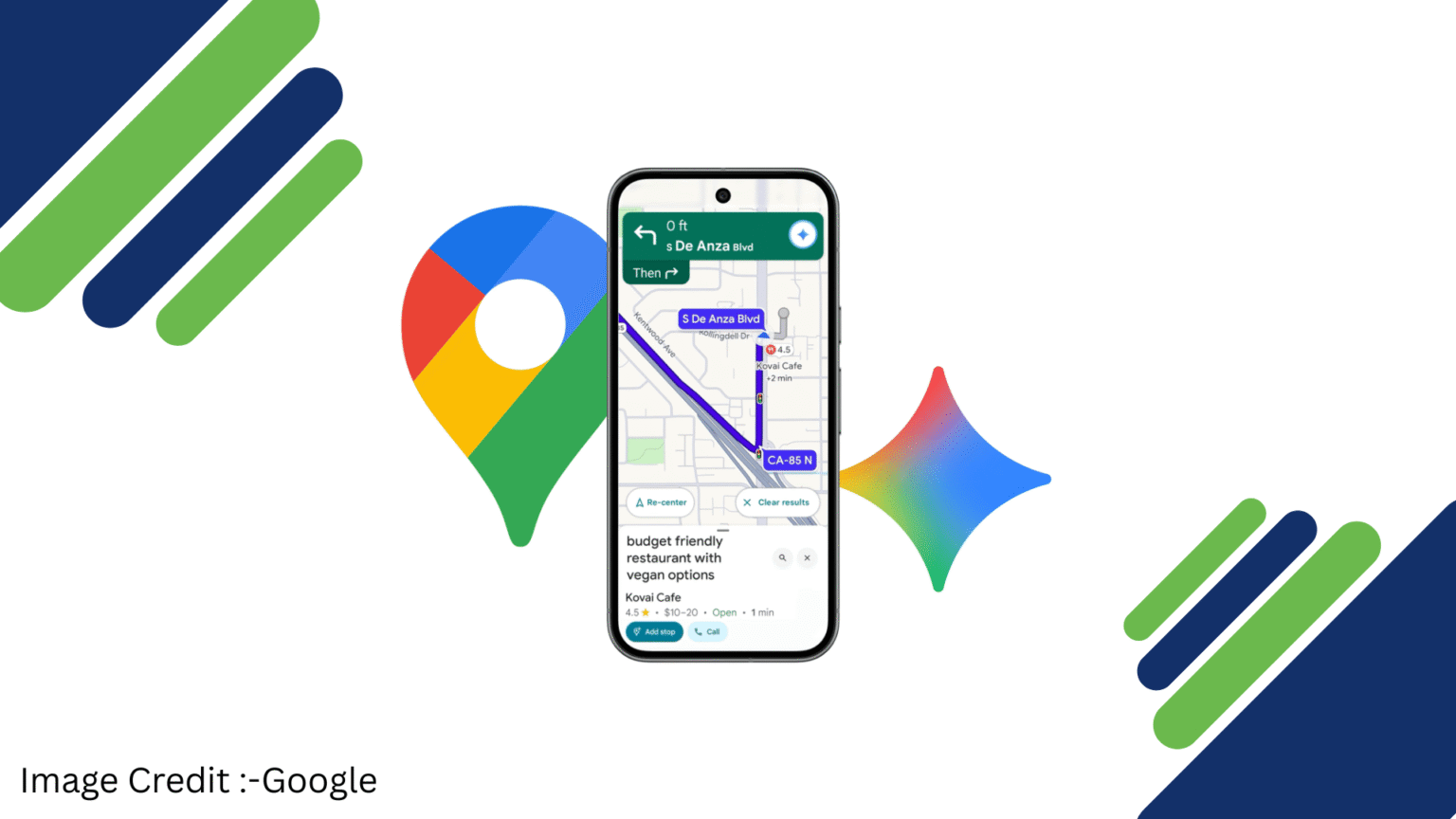


Incorporation of Google Maps within Gemini is one important step that it will make in the way we relate to location-based information. Google Maps within Google Gemini is changing basic navigation into a smarter, conversational experience through the combination of intelligence of AI with real time mapping.
Historically, it was possible to use Google Maps to type in a destination, view routes and use a manual exploration of the places around. Although effective it involved the user having to alternate between thinking, searching and deciding. In Gemini, all that is more natural. Users do not have to search in bits; all they do is query questions such as, Find me the best cafes near me with good reviews and a quiet environment and Gemini comprehends the meaning of the query.
Herein lies the true strength which is contextual knowledge. Gemini does not simply fish out some arbitrary results; it interprets preferences, location, time and even intent. As an example, when you request romantic places near by to have dinner, it will not only provide the restaurants, it will also indicate places with a feel, rating and on which you can have a date. This makes Google Maps less of an application but rather a personal travel guide.
Conversational navigation is also another significant benefit. Users do not have to repeat the search again and again, but refine them automatically. You may open with Show me tourist places in Delhi then proceed with Which are not crowded and then how do I reach there by metro? Gemini monitors the dialogue and reacts to it. This helps in saving time on re-searching and its removal.
To the travellers, this integration is a game changer. Most of the time when planning a trip, several apps are used, such as maps, reviews, blogs, and itineraries. Through the collaboration of Gemini and Google Maps, much of that planning can take place in a single location. You have the option of requesting a complete itinerary of a day, directions, travel duration and even finding out the pearls within the same interface. It helps to simplify the process of decision making and makes the whole process of traveling easier.
It is also an evolution that is beneficial to the businesses. The businesses that are found on Google Maps are now more likely to be found in a personalized and intentional search. Visibility is not as limited to keywords alone, but rather can be based on the match of business to user intent. As an example, a small cafe with fantastic atmosphere may appear when one requests to know where to have a coffee in order to work, though this may not be the most well-known one. This opens up opportunities of niche businesses emerging out.
Technologically, this integration is an indication of a larger trend: the integration of AI with common usage products. Google is evidently trying to smarter and more interconnected with its ecosystem. Introducing Gemini as an integration into applications such as Maps makes sure that customers remain on its platform and receive a more enriching, more intuitive experience.
This is also a significant change in user behavior. Instead of search using key words, people are using the conversational searches. They do not type best restaurants Delhi anymore; they would rather pose full questions. This implies that the future of the search and local discovery will be extremely determined by the ability of platforms to comprehend natural language. The fact that Gemini is integrated with Google Maps is a good move towards the same.
Nevertheless, this innovation is associated with challenges too. In this case, accuracy and trust would be even more crucial when AI is suggesting something. Users should have the impression that the suggestions are valid and current. Google will have to constantly improve the responses of Gemini so that it is quality and relevant.
To sum up, Google Maps and Gemini are not simply a feature improvement but a transition to more intelligent AI-powered destination discovery and navigation. It transforms maps into a living guru that does not only tell you where to go but also assists you in choosing the reasons and ways of going where. With the development of this technology, it can transform the way we learn the world by making any trip more customized, effective, and intelligent.