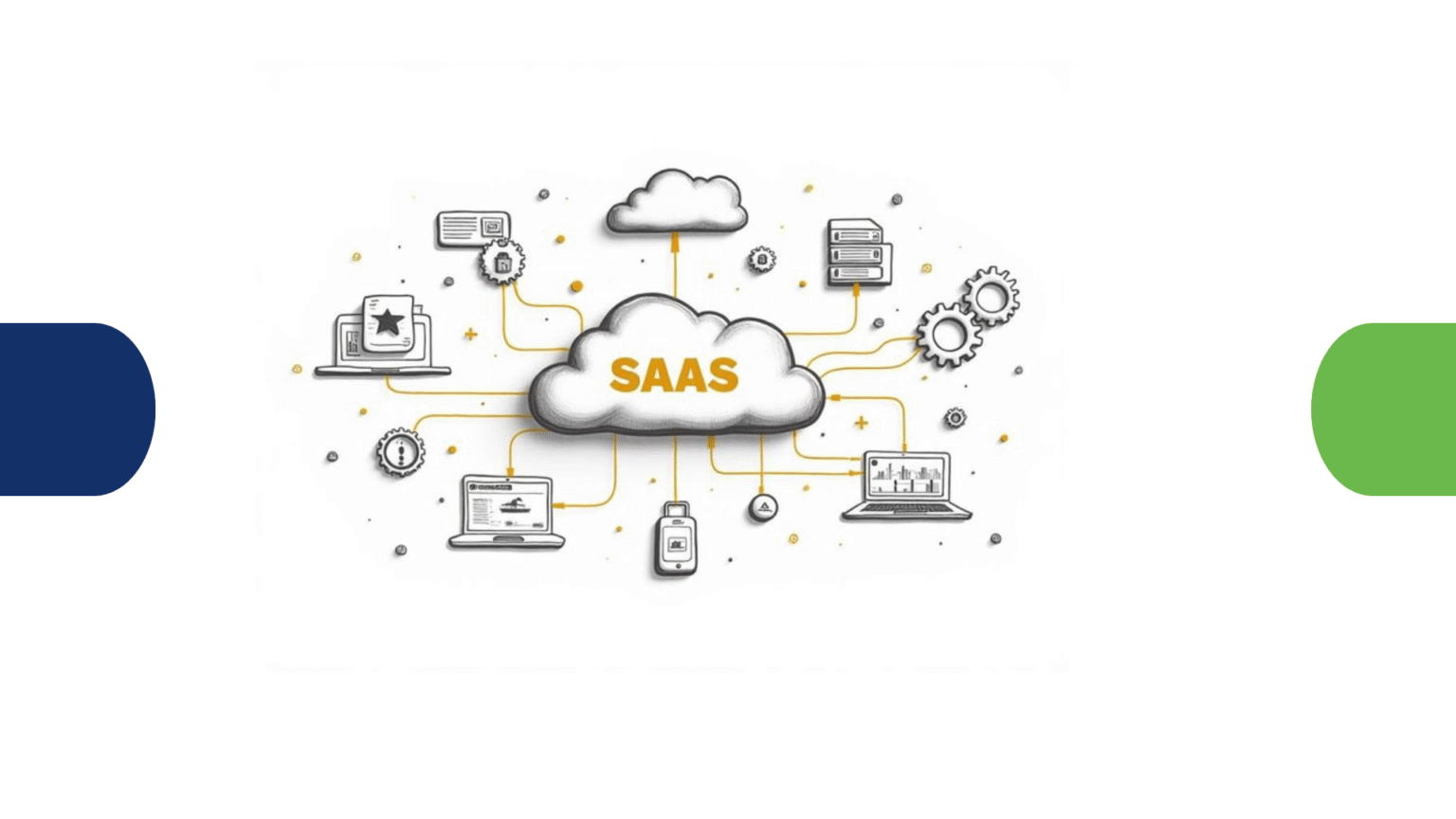


The SaaS market is experiencing a significant change. What used to be considered a successful software-good user workflows, integrations, interfaces and experiences are being put into question by the fast-growing AI agents.
What is being emphasized now is not the method of doing work, but whether there is any work done at all.
Between Workflow Ownership and Outcome Ownership.
SaaS products have traditionally oriented their value creation by integrating themselves into user workflows. The tools such as project management tools, CRM, and developer environments succeeded since they dictated the way the users spent time with their work.
But the coming up of AI agents is altering this situation.
AI systems are gaining the ability to undertake tasks on their own without the need of users to adhere to defined work processes. This implies that developers and businesses are no longer attaching importance to the process, they are more concerned with the end result.
It is difficult to describe in simple terms, but one product owns the workflow, and another one delivers the result. And nowadays, outcomes are triumphant.
Stickiness in Workflows on the Decline.
SaaS firms used to pay excessive attention to workflow stickiness, or retaining a user within their systems as long as possible. The longer time users were spending within a product, the greater was its competitive advantage.
However, this model is currently being challenged.
The human being will not have to stay in a software environment as AI agents perform the duties. When an AI is capable of performing a task on its own, the need to maintain the user involved in a particular workflow does not make much sense anymore.
This change puts one urgent question:
- When humans are no longer the main drivers within software, then does workflow stickiness become a concern?
- Integrations are becoming a Commodity.
- The other significant change is occurring in the integrations world.
In the past, SaaS platforms established high moats through the provision of various integrations with non-linked tools and systems. Being a connector of various services was regarded as a significant benefit.
Today, due to the development of such protocols as model context protocols (MCP), AI-native connectivity, and similar methods, it is much easier to connect with external data sources.
The businesses no more have to create or maintain dozens of custom integrations. The AI model can directly integrate with other systems eliminating integrations as a differentiator.
The Threat of Substitutes of SaaS with Easy Replicability.
The emergence of products that are easily copied is one of the largest issues of the current SaaS environment.
There is an increasing vulnerability of basic productivity tools, simple project management platforms, lightweight CRM systems, and AI wrappers based on existing API. In the event a product is more of an interface layer and lacks strong functionality or proprietary data, it can be recreated by an experienced AI-native team within a short time.
This has gotten investors more reserved. Things that are not profound, have no distinctive information, or are not embedded with knowledge are no longer perceived as defensible.
The reason AI-Native Startups are winning
Unlike AI-native startups, they are coming into the market with an entirely different approach. Rather than developing tools based on user processes, they are developing systems that:
Execute tasks autonomously
Get educated by data constantly.
Integrates easily without complex set up.
Concentrate on results and not interfaces.
This makes them quicker, efficient and in many cases useful than the conventional SaaS products.
Consequently, a large number of SaaS legacy firms are experiencing reduced valuations, and AI-driven platforms are gaining traction.
What Still Makes SaaS Worthwhile?
SaaS is hardly out of date despite these disruptions. Actually, it is becoming more evident what its most valuable features are.
The future of products is of the type that provides:
- Integration with the critical workflows and not shallow interaction.
- Ownership of high quality proprietary data which cannot be easily copied.
- Good domain knowledge integrated into the product.
- Artificial intelligence is not merely a feature, but it is central to the product experience.
As it were, it is more about depth than breadth.
The New SaaS Playbook
The SaaS companies must reconsider their approach in order to remain competitive in this changing environment:
They have to be more than mere tools and more intelligent systems.
AI is not to be superficially placed on top of the product but rather it should be part of the product.
This change should be clearly explained to users and investors by marketing.
Above all, enterprises must aim at possession of results, rather than processes.
Conclusion
The SaaS sector is at a new stage – the one that AI agents are reshaping the way software is developed, consumed and appreciated.
Unless a product is based on user workflow, simple integrations, or features that can be very easily copied and replicated, it will not survive. Conversely, solutions that introduce AI, extensive domain knowledge, and an understanding of vital processes will endure.
The message is clear:
In the era of AI, managing work is not going to be a winning game, but the one who does the work is.